The Solukon team is happy to reconnect with the US AM community again – this year in Chicago, Illinois. Here’s what to expect at booth 1820.
New Products to present at Rapid + TCT
The Solukon team is excited to present two new products at this years Rapid + TCT show.
Special version of SFM-AT1000-S with front-top-loading and short arm
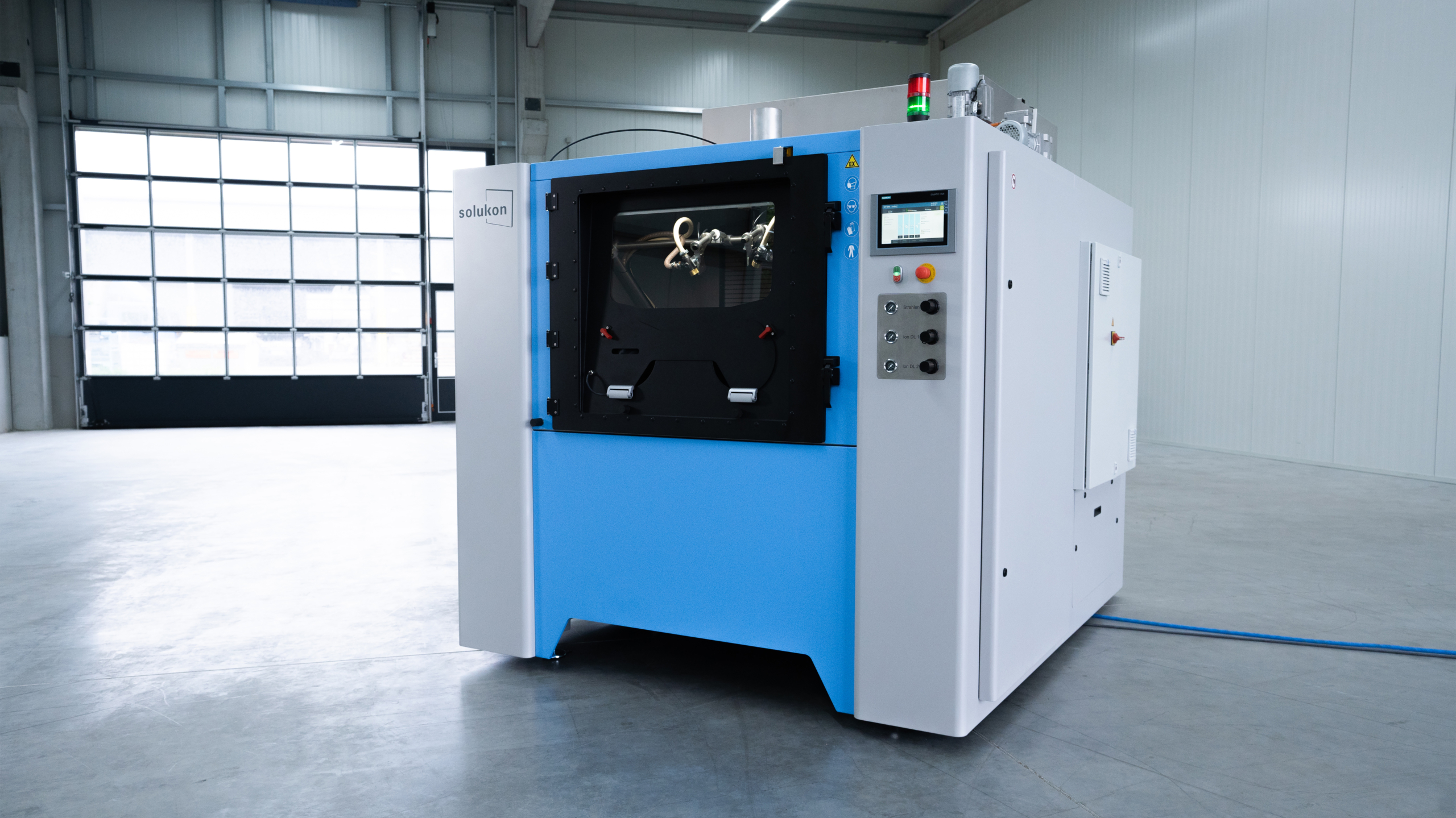
Solukon now offers a version of the SFM-AT1000-S with a short swivel arm. This short-arm SFM-AT1000-S is the right system for parts up to 660 mm in height (incl. build platform) that have their center of gravity closer to the rotational axis of the swivel arm. This is the case for parts printed on an SLM NXG XII 600 or a Velo Sapphire XC among others.
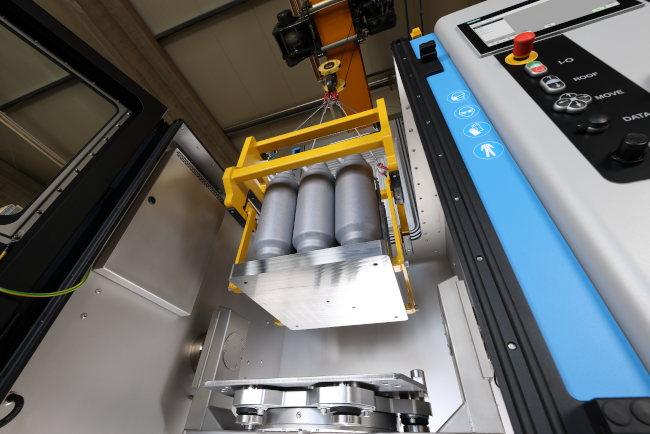
It’s now even easier to load the SFM-AT1000-S, thanks to the pneumatic top. When the top opens, it folds up together with the upper door frame, so that the part can be inserted at turntable height with even more flexibility – it’s no longer necessary to ”thread in” the part from above. This enables particularly large and heavy parts to be lifted easily and conveniently into the system via crane.
The new front-top-loading option of SFM-AT1000-S.
SPR-Pathfinder®-Software
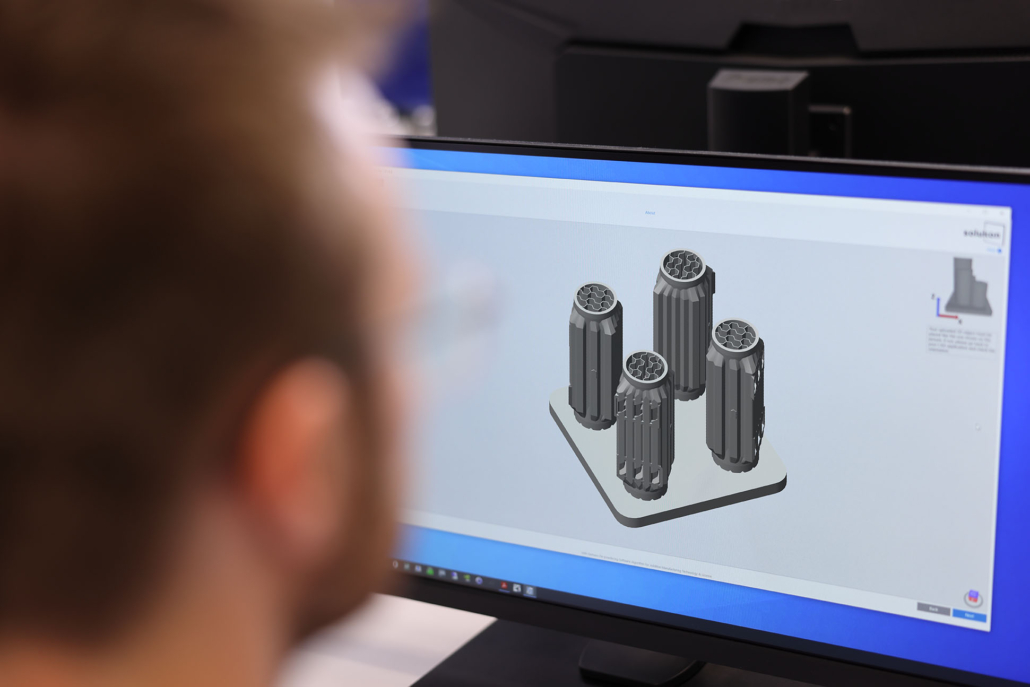
Solukon will publicy present the brand-new software for digital depowdering at Rapid +TCT 2023. Using a transparent heat exchanger, we will demonstrate how SPR-Pathfinder® software depowders even the most complex geometries in an SFM-AT800-S.
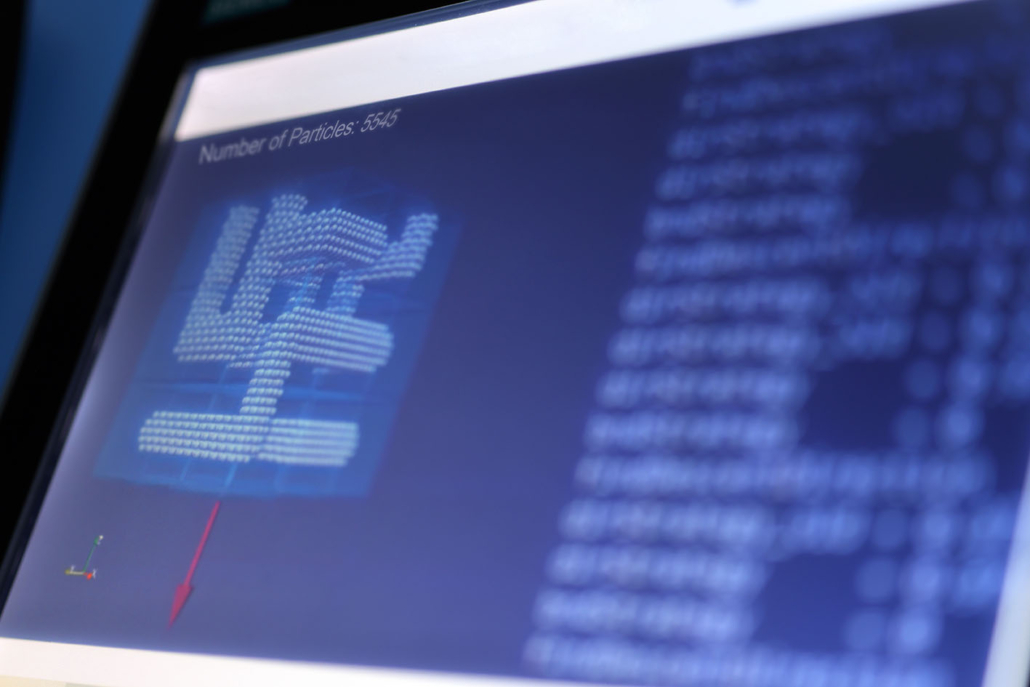
SPR-Pathfinder® software interface.
Explore our metal depowdering systems live
We’re happy to have three metal depowdering systems on display.
The SFM-AT350, the new standard for medium-sized parts
TheSFM-AT800-S, the award-winning flagship for complex geometries showcasing SPR-Pathfinder®
The SFM-AT1000-S in the short-arm version with front-top-loading
Recently, Solukon has launched the first depowdering software, the SPR-Pathfinder®. Learn in the Q&A of TCT magazine what makes this software an efficiency booster in postprocessing.
What motivated Solukon to launch the SPR-Pathfinder®?
It’s always been Solukon’s ambition to automate and simplify powder removal. In 2018, Solukon CEO Andreas Hartmann discussed the potential for an algorithm-based depowdering mode with Dr. Christoph Kiener, Principal Key Expert on Functional Design for Manufacturing at Siemens Technology. We were sure that metal parts might get too complex to let humans do the programming of the depowdering motion pattern. Developed by Siemens Technology in a joint project with Solukon, the software was unveiled publicly for the first time in 2018 under the name SiDAM.
After a successful testing phase SiDAM turned out to be the game-changer for automated depowdering that we intended it to be. So, Solukon has acquired exclusive rights to the software, developed it into a Solukon product, and brought it to the AM market under the new name, SPR-Pathfinder®.
What are the fundamental capabilities of the product?
SPR-Pathfinder® software uses the build job’s CAD file to calculate the ideal motion in the Solukon system. The software calculations are based on a flow simulation that analyzes the part’s digital twin. The individually calculated motion sequence is then read by the Solukon system, which in turn runs the programmed paths.
SPR-Pathfinder® can currently run on SFM-AT800-S and SFM-AT1000-S models.
What are the benefits of using SPR-Pathfinder® in real-terms?
The SPR-Pathfinder® is a fire-and-forget software. So you basically load the CAD file in binary format into the software and it does the rest. So, there is no human programming or teaching of depowdering motion sequences required anymore.
Significant time savings – No time is needed for programming anymore and users have more time for more valuable working steps in the process.
With the software you get an optimized degree of part cleanliness especially for components with intricate internal channels.
The SPR-Pathfinder® paves the way to a true serial cleaning and therefore to serial production. Obviously, SPR-Pathfinder® executes the same cleaning program for the same kind of parts.
SPR-Pathfinder® is able to calculate the motion sequence for the whole build job, i.e. even for different parts on one build plate simultaneously. This means another booster in efficiency for AM productions with a greater variance of components.
As soon as the CAD file of the component is ready, SPRPathfinder® can calculate the depowdering motion patters. So, the depowdering can be arranged even when the printing of the part is still in progress. The software also ensures part cleanliness, so designers can freely design their components and do not need to consider any obstacles in depowdering.
Why is creating a digital twin for the postprocessing of parts important?
Creating and working with a digital twin in postprocessing makes the process steps after printing predictable and scalable even if the parts are still in production. Before SPR-Pathfinder ® was launched the digital twin was just usable in the printing process but not in any subsequent process steps. For a total digital manufacturing process, the postprocessing needs to be digital to a certain degree. The digital twin is one tool for that, alongside sensors and digital interfaces.
And how does the software integrate with the rest of the additive manufacturing workflow?
The software itself works not in the Solukon system but on a PC or laptop via any recent windows operating system, giving maximum flexibility. Via OPC UA you can load and start the cleaning program, calculated by SPR-Pathfinder® in the Solukon system. Just like the Solukon systems themselves, the SPR-Pathfinder® is compatible with every 3D printing system and peripheral equipment on the market.
With adapters for EOS P 1 and P 5 series SLS manufacturing systems, the Solukon SFP770 postprocessing system for polymer parts can now accommodate build boxes from other leading printers. These will enable Solukon to tap new markets in the area of polymer postprocessing. Furthermore, the SFP770’s unique unpacking device has been successfully patented.
Solukon introduced the SFP770 for the first time in the fall of 2020, presenting it as a postprocessing system for plastic parts manufactured by a P 7 series EOS printer. An automotive industry customer approached Solukon with a request to be able to both unpack and clean polymer components automatically, without the user coming into contact with the plastic powder. With consideration for every requirement—such as compact design and maximum flexibility—Solukon CEO and CTO Andreas Hartmann developed the perfect system in just a few months, the SFP770.
The polymer postprocessing system SFP770 by Solukon.
SFP770’s one-of-a-kind operating principle
Globally, the SFP770 is a one-of-a-kind postprocessing system. It is the only one to include both an automated unpacking station and a cleaning station for SLS components in just one system. The station is compatible with EOS P 7 series systems and encompasses the 3D printer’s entire build box. Thanks to the new adapters, the SFP770 can also integrate build boxes from P 1 and P 5 EOS printers.
The SFP770’s process is as follows:
1. Loading
The build box is placed in the system by a lift truck.
2. Unpacking
A vibrating sieve cover is placed over the inserted build box, which then rotates gently overhead following an optional programmable process, gradually separating the components from the powder. The loose powder is extracted from the sieve cover directly and without contamination and conveyed to a recycling unit or storage silo.
3. Transferring
Once the unpacking process is complete, the build box rotates towards the basket and opens the sieve cover. The sieve cover now functions as a slide and the parts are slipped carefully into the basket. If necessary, the automatic transfer process can be paused to manually remove certain components that should not be cleaned automatically.
After transfer, the system can immediately be loaded with a new build box, while the components from the first batch are cleaned in the second half of the system, the basket.
4. Cleaning
The basket rotates in the direction of the blasting unit and begins turning. The glass bead blast and ionized air cleaning process is fully automated and removes residual powder. Process parameters, such as rotation angle, blast intensity, distance or basket rotation, can be easily programmed online by the user.
The new product video illustrates the system’s operating principle. It shows the handling of a P 7 build box.
You are currently viewing a placeholder content from YouTube. To access the actual content, click the button below. Please note that doing so will share data with third-party providers.
With the SFP770, Solukon is paving the way to fully automated postprocessing and thus the industrialization of 3D printing.
Automation of both the unpacking process and the transfer to the cleaning process means that the operator has almost no contact with the powder. This combination of unpacking and cleaning in one system makes “dust-free AM production” possible. The automation and combination of two high-cost secondary processing steps also increases the acceptance and feasibility of industrial AM production.
Combining unpacking and cleaning in one system, the dust-free AM factory becomes viable.
The flexible programming of the postprocessing system is another great advantage.
“Because so many process parameters can be programmed, the SFP770 achieves the best cleaning results, independent of build material and without manual intermediate steps. Our system offers another advantage: parts of varying shapes and sizes can be cleaned simultaneously, which increases the flexibility and productivity of AM production,” says Andreas Hartmann, CEO and CTO of Solukon.
In addition to the cleaning process itself, Solukon’s SFP770 also optimizes the preparation of the blast material, i.e., the glass beads. While standard systems typically separate glass beads from plastic powder using air separators or cyclones, Solukon uses ultrasonic sieves. This produces incredibly clean glass beads, resulting in almost no losses.
Adapters for increased compatibility
Thanks to new adapters, the SFP770 can now also accommodate and clean parts manufactured with EOS P 1 or P 5 systems. “We’ve received several requests for a postprocessing system, especially for the EOS P 500. Since the EOS P 500 is a standard plastic printer, our SFP770 postprocessing system paired with the correct adapter is now available to a much larger user base,” Andreas Hartmann is happy to report.
Patented technology
On a further positive note, the SFP770’s unpacking device is now protected by the European Patent EP 3 789 184 B1. This patent grant underscores the novelty of this operating principle and protects the system’s high level of innovation.
The future of polymer postprocessing
Following the successful introduction and nearly two-year implementation of the SFP770 in industrial manufacturing environments, Solukon sees itself well prepared for future integration of the SFP770 in fully automated manufacturing systems.
“We expect plastics manufacturing to trend strongly towards a focus on postprocessing, because it constitutes the decisive step in determining if something is truly manufactured in series or not. You can optimize a manufacturing process for serial production as much as you want, but if the subsequent postprocessing fails to meet the same high standards, you will not have true serial production. At Solukon, we therefore expect to see an increased demand for automated unpacking and cleaning stations. Thus, we are also ready to automate the loading and unloading steps. Discussions with international manufacturers and system suppliers are already in full swing. We are proud to be able to participate in the future of additive manufacturing in this area,” Andreas Hartmann says happily.
The Solukon team is happy to join the Additive Manufacturing User Group again.
AMUG is a global community focused on accelerating the education and advancement of additive manufacturing and 3D printing. The Additive Manufacturing Users Group (AMUG) Conference brings together engineers, designers, managers, and educators from around the world to share expertise and best-practices in additive manufacturing.
This year’s AMUG takes place in Hilton Hotel, Chicago Illinois.
Solukon will exhibit at AMUGExpo (March 19 and 20) this year. Meet our CEO, Andreas Hartmann and our Global Sales Director Michael Sattler at the Solukon booth 22 in Salon A.
The Solukon team is looking forward to discuss your depowdering application with you. See you soon!
The Solukon team is happy to reconnect with the AM community again. Here’s what to expect on booth 12.0, B21.
Presentation of SPR-Pathfinder®
Solukon will publicy present the brand-new software for digital depowdering at Formnext. Using a transparent heat exchanger, we will demonstrate how SPR-Pathfinder® software depowders even the most complex geometries in an SFM-AT800-S.
Explore our metal depowdering systems live
We’re happy to have all four metal depowdering systems on display.
The SFM-AT200, the entry-level system for medical components
The SFM-AT350, the new standard for medium-sized parts
The SFM-AT800-S, the award-winning flagship for complex geometries
The SFM-AT1000-S for extraordinary large part dimensions
Learn about our polymer powder removal system
Our SFP770 is the world’s first postprocessing system to include both an automatic unpacking station and a cleaning station for SLS components in one system. Diagrams and videos will explain the design of the SFP770.
Explore a unique case study about Depowdering in New Space
a joint presentation of Solukon and Morf3D on Tuesday, November 15, 3.40 PM
Delivering an SFM-AT800-S for the depowdering of laser melted metal parts to the Swiss manufacturer of satellite components SWISSto12, Solukon reaches a milestone in its still young corporate history.
With the foundation of the company and the introduction of the SPR® (Smart Powder Recuperation) depowdering technology in 2015, Solukon has revolutionized the postprocessing of laser melted metal parts. The Solukon SFM-AT800 system introduced at that time was the world’s first industrial system for automated depowdering, where the component is moved around two axes in a protected atmosphere. In combination with rotation, the powder is removed by targeted frequency excitation and collected for reuse.
Pioneer of an entire industry
Since its foundation, Solukon has committed to the mission to point out the risks of manual depowdering and to establish automated depowdering in the international 3D printing market. With well-known customers and partnerships with leading OEMs, the company has significantly optimized postprocessing in terms of occupational safety and efficiency. Across the industry, this has in turn led to greater acceptance of industrial depowdering.
In just a few years, Solukon, as an owner-managed company, has established four different systems for powder removal from metal components on the market. The company now has installed depowdering systems in 28 countries, with even more to follow. In addition to the now 200 metal machines, Solukon has many other machines in the field, including postprocessing systems for polymer, and supplies OEMs with system solutions for their product portfolio. The company does not concentrate on the development of the depowdering systems alone. Solukon has also developed solutions for quality management and integration into fully automated processes, as well as intelligent software in cooperation with Siemens, the SPR-Pathfinder®.
Aerospace as the top industry for automated depowdering
The fact that SWISSto12, a company from the aerospace industry, is now receiving the Solukon’s 200th metal system reflects the trend. “Aerospace is the industry with the most Solukon systems in the field, because the requirements for repeatable and reliable post-processing are particularly high here,” says Andreas Hartmann, CEO and CTO of Solukon.
Mathieu Billod, Head of Manufacturing at SWISSto12 und Alban Mourier, Process Engineer (f.l.t.r.) in front of their brand-new Solukon SFM-AT800-S. Image: SWISSto12
SWISSto12 also uses the Solukon system to clean complex parts fully automatically. Using additive manufacturing, the company, among other products, supplies Radio Frequency antenna components and complex waveguide structures which are needed for satellite telecommunications. “By using additive manufacturing methods, we achieve a significant reduction in weight and costs as well as excellent frequency performance for our antennas. With the Solukon SFM-AT800-S, we depowder the printed parts reliably and quickly. Due to the unlimited freedom of motion, even complex structures inside the parts become powder-free,” says Mathieu Billod, Head of Manufacturing Technology at SWISSto12, who received the 200th Solukon system.
For Solukon, the 200th delivery of a depowdering system is another milestone. “We are honored that so many well-known companies, institutes and OEMs trust in our technology. For us, this means another kick to always grow with the challenges of our customers,” Andreas Hartmann happily shares. The next highlight for Solukon is just around the corner. At Formnext 2022, the Augsburg-based machine manufacturer will publicly present the brand-new depowdering software SPR-Pathfinder® for the first time.
Solukon will present the automatic depowdering software to the public at Formnext 2022. By commercializing the software as its own product, the Augsburg company, Solukon, reinforces its role as a pioneer in the industrialization of automatic depowdering. Furthermore, with the SPR-Pathfinder®, Solukon makes the digital twin of a part usable in postprocessing for the first time.
The increasingly complex applications of powder-based 3D printing have led to increasing demands on industrial depowdering. After introducing its Digital-Factory-Tool last year, a sensor and interface kit for quality assurance and automation integration, Solukon is taking the next step in 2022. The Augsburg company is launching the SPR-Pathfinder® depowdering software on the market.
To remove excess powder from complex internal structures, SPR-Pathfinder® uses the build job’s CAD file to calculate the ideal motion sequence in the Solukon system. The SPR-Pathfinder® calculations are based on a flow simulation that analyzes the part’s digital twin. The individually calculated motion sequence is then read by the Solukon system, which in turn runs the programmed paths. This ensures that even the most complex parts are cleaned—in record time and without any human programming effort. “In contrast to conventional manufacturing processes, 3D printing uses the part’s digital twin. To date, however, this was only utilized during the printing itself. With SPR-Pathfinder®, the part’s digital twin can now also be used during depowdering. This is how we ensure that the potential of the digital twin can be used to the fullest in postprocessing as well,” says Andreas Hartmann, CEO/CTO of Solukon.
SPR-Pathfinder® calculates the cleaning sequence of a complete build job.
Experienced depowdering pioneer acquires license for award-winning depowdering software
In 2018, the software developed by Siemens Technology in a joint project with Solukon was unveiled publicly for the first time under the name SiDAM.The software was the brainchild of Dr. Christoph Kiener, Principal Key Expert on Functional Design for Manufacturing at Siemens Technology. “Vibration-excited powder behaves almost like a fluid when it flows out. That’s how we quickly realized that we could find success by using path identification as well as particle and flow simulation in the software,” says Kiener. Even back then, the announcement caused a sensation when Solukon and Siemens received the TCT Postprocessing Award 2019 for their use of the software in a Solukon SFM-AT800-S.
The calculations of SPR-Pathfinder® are based on a flow simulation.
Until recently, the software prototype was only available to a select number of Siemens’ and Solukon’s development partners. Now, Solukon has acquired exclusive rights to the software, developed it into a Solukon product, and is bringing it to the AM market under the new name, SPR-Pathfinder®, enabling Solukon customers to purchase licenses for the first time. “It’s a logical step for us to license the depowdering software exclusively to Solukon, thereby enabling the pioneer in industrial depowdering to offer the market an even more effective product,” says Dr. Georg Bodammer, Senior Venture Director at Siemens Technology Accelerator. “This way, customers can get everything from a single source: the market-leading depowdering system and the exclusive, intelligent software.”
In naming the software, Solukon deliberately drew on the established depowdering technology Smart Powder Recuperation, also known as SPR®. SPR® generally involves automated rotation on two axes as well as adjustable vibration in a safety-controlled atmosphere. The algorithm-based SPR-Pathfinder® calculates the ideal motion sequence for the most complex geometries, finding the best path to allow the powder to flow out completely.
SPR-Pathfinder® available now
As an exclusive Solukon product, SPR-Pathfinder® is only compatible with Solukon depowdering systems. The software can currently run on SFM-AT800-S and SFM-AT1000-S models—already starting with serial number 1 of those models. “It is very important to us that the widest possible customer base can benefit from our software from the moment it hits the market,” says Andreas Hartmann, CEO and CTO at Solukon. In the future, the software should also be compatible with other models, such as the SFM-AT350.
SPR-Pathfinder® runs as on-premises software —in other words, on the respective company’s own devices (PC or notebook), not in the cloud. Each license is bound to a device and is always valid for the current version at the time of purchase.
Depowdering software already validated by pilot customers
Prior to market launch, Solukon had the software thoroughly tested by several notable pilot customers, including Siemens Energy in Berlin, who has been using the SiDAM, or Pathfinder software, for quite some time as part of a joint development project.
Siemens Energy is a global leader in energy technology. The company works on the energy systems of the future together with its customers and partners, thereby supporting the transition to a more sustainable world. The globally active company has a portfolio that includes both conventional and renewable energy technologies, such as gas and steam turbines, hydrogen-fueled hybrid power plants, generators, and transformers. The AM team in Berlin manufactures hot gas parts in series via 3D printing processes and has been using a Solukon SFM-AT800-S for their depowdering needs for the past two and a half years. “With SPR-Pathfinder®, we can depowder in series without any manual programming. The parts are guaranteed to be clean and this guarantee, in turn, allows us complete freedom in part design. Furthermore, we save a lot of time, which we can then dedicate to other value-adding activities in the manufacturing process,” says Julius Schurb, Project Leader for IDEA (Industrialization of Digital Engineering and Additive Manufacturing) at Siemens Energy.
The Siemens Energy use case is also included in the brand-new SPR-Pathfinder® product video that explains the intelligent depowdering process.
You are currently viewing a placeholder content from YouTube. To access the actual content, click the button below. Please note that doing so will share data with third-party providers.
Intelligent depowdering process with SPR-Pathfinder®
Intelligent depowdering with SPR-Pathfinder® always follows the same procedure:
1. Upload the file to SPR-Pathfinder®
The user uploads the part’s CAD file in STL-format using drag and drop or the file browser.
2. Set the calculation parameters
This includes information on the material and desired waiting times for individual directions of motion.
3. Specify the storage location
The user can store the depowdering sequence to be calculated either locally or save them on an external storage device (e.g., USB stick).
4. Start the calculation
The calculation time varies depending on the device’s processing power and the complexity of the part.
5. Transfer the cleaning program to the Solukon system
The individual cleaning program can be loaded into the Solukon system via USB stick or OPC UA (optional, upon request).
Software to be presented at Formnext 2022
Solukon will publicly present the software for the first time at Formnext 2022 (November 15-18). Using a transparent heat exchanger, the machine manufacturer will demonstrate how SPR-Pathfinder® software depowders even the most complex geometries in an SFM-AT800-S. The Solukon team looks forward to welcoming visitors at Booth 12.0, B21. In addition to the software, all four metal systems will also be on display. We’re certain the impressive parts in the depowdering systems will once again attract a great deal of attention. For the first time ever, Solukon will also address the unpacking and depowdering of polymer parts at its booth. Diagrams and videos will explain the design of the SFP770.
“Formnext 2022 will be a real highlight. We look forward to introducing SPR-Pathfinder® to our customers there. The commercialization of the first depowdering software in the world is a milestone for Solukon as well as for the entire AM sector. This is because the software enables true serial cleaning of any geometry without any human programming,” Solukon CEO Andreas Hartmann happily shares.
If you were to ask AM experts which application has inspired the community the most in recent weeks, the answer is likely to be: the Aerospike part. This is a rocket engine designed by Hyperganic and manufactured by EOS and AMCM. Unlike conventional bell-shaped nozzles, an aerospike engine maintains its aerodynamic efficiency across a wide range of altitudes. But the geometry is a tremendous engineering and manufacturing challenge. Hyperganic’s algorithm-based design made it possible to print this component on an EOS system (material: Inconel 718) or, in a larger version made of copper, on an M 4K system from AMCM. Afterwards, the part was depowdered in a Solukon powder removal system (SFM-AT1000-S). But why is depowdering more than just the next logical step right after printing?
Why the SPR® depowdering technology is key
Compared to manual depowdering automated depowdering offers many advantages: increased health and occupational safety, time savings up to 90% and contamination-free powder recovery. With regard to the aerospike part one thing is particularly obvious: Automated depowdering is reliable and repeatable. This means that you get the powder out of even the most complicated channels. Part designers therefore can freely design without any restrictions since the Solukon gets every geometry powder-free. Real freedom of motion makes this possible, enabled by endless two-axis rotation within the Solukon systems SFM-AT800-S and SFM-AT1000-S. This means that AM users no longer have to worry if internal cavities have been created too small and whether stuck powder is causing problems in downstream processes. They can create channels in the way that makes the most sense in terms of thermal conductivity and performance.
Depowdering of a copper aerospike nozzle (printed on an AMCM M4K printer) in a Solukon SFM-AT1000-S (credits: AMCM).
Serial cleaning and comprehensive monitoring
Depowdering complex parts like the aerospike is no one-off task since more and more complex applications are going into series. What is printed in series needs to be depowdered in series, too. Solukon systems provide the perfect conditions for this. You can save motion sequences as a profile and run it repeatedly for the same batch. For particularly challenging geometries, a software calculates the ideal motion sequence, which is then available as a program. Thus, you always get the same, reliable cleaning result for each component. In addition, Solukon offers full process transparency: With the Digital Factory Tool, a comprehensive quality report on the depowdering process is available at the end.
Automated depowdering with Solukon’s SPR® technology is a game-changer towards a real freedom in part design and stands for reliable cleaning results and overall process transparency. That is why leading OEMs, such as EOS and AMCM, rely on Solukon as their partner for industrial depowdering.
At acatech’s senate event at Siemens headquarters in Munich Solukon shows how intelligent depowdering based on the digital twin is driving the industrialization of 3D printing.
The National Academy of Science and Engineering, or acatech, an organization funded by the German federal and state governments, is the voice of the technological sciences at home and abroad. Its Senate, consisting of 105 well-known personalities from internationally leading German tech companies, held its annual meeting at Siemens headquarters in Munich. The event addressed important future topics of the industry such as sustainability of digital transformation processes or global supply chains. Another focus was the digital twin area. Here, in the so-called Real Life Experience, Siemens took the senators to use cases in which the digital twin is already being applied. One of these is the intelligent software in a Solukon SFM-AT800-S.
Algorithm-based industrial depowdering
Christoph Kiener, Principal Key Expert Functional Design for Manufacturing at Siemens, and Solukon CEO Andreas Hartmann showed the senators, how algorithm-based depowdering increases efficiency in postprocessing of additive manufacturing. Flow simulation is key for software-controlled depowdering. It analyses the geometry of the digital twin of the part to find the corresponding motion sequence within the Solukon system. Applying the algorithmic depowdering, you can clean even the most complex parts reliably and fast. For subsequent cleaning jobs you can use the motion sequence as a program.
The senators, including host Roland Busch, CEO of Siemens, experienced the performance and significance of algorithm-based depowdering.
Roland Busch, CEO of Siemens, is shown the intelligent depowdering process in a Solukon SFM-AT800-S. Image: Siemens
“Solukon’s intelligent depowdering process is one of the lighthouse projects that shows how the digital twin and artificial intelligence make a difference in the industry”, says Christoph Kiener. Kiener had developed the intelligent Solukon depowdering software in 2018. In combination with the SPR® depowdering technology, this makes Solukon the market’s sole provider of intelligent powder removal, i.e. depowdering based on an algorithm.
Christoph Kiener and Andreas Hartmann present the depowdering software to Ulrich Eichhorn (VW), Roland Busch (Siemens) and Sabine Klauke (Airbus) (from left to right). Image: Siemens
Long-standing partnership between Solukon und Siemens
Solukon has a long-standing partnership with Siemens. “Solukon is not only a customer and licensee of Siemens, but also a supplier and partner”, says Kiener. The Solukon managers were all the more pleased to be able to present Solukon technology at this high-class event. “It was an honor for Solukon to show the depowdering software as a co-innovation of Siemens and Solukon at the acatech senate event”, summarizes Solukon CEO Andreas Hartmann.
The Solukon team is happy to reconnect with the US AM community again.
It’s time for face-to-face events again. As the US AM market is a highly valued and significant one for Solukon, the machine manufacturer is delighted to exhibit at two leading US trade shows in May. The depowdering pioneer will be at Rapid + TCT in Detroit, Michigan and at Space Tech Expo in Long Beach, California.
Learn about a unique case study about Depowdering in New Space: a joint presentation of Solukon and Morf3D on May 19, 11 AM
For the first time ever, Morf3D and Solukon have jointly investigated how automated depowdering pushes the boundaries of 3D printable metal parts, paving the way to a real freedom in part design. Only if even the finest channels of a rocket engine or combustion chamber are free of powder (which is achieved through automated depowdering in the first place), components are ready for serial production and the New Space Race is on. In the presentation Michael and Franck will propose a generic use case that includes challenging features like gyroid structures, thin walls and intricate internal channels.
Right after Rapid + TCT the journey continues to California: Solukon will exhibit at Space Tech Expo in Long Beach for the first time. Space Tech Expo is the West Coast’s must-attend B2B exhibition and conference for space technology and services. Meet the Solukon team at booth 1017 and learn how automated depowdering can be a game-changer in AM for Space.
You are currently viewing a placeholder content from Turnstile. To access the actual content, click the button below. Please note that doing so will share data with third-party providers.