The Solukon team is happy to reconnect with the US AM community again – this year in Chicago, Illinois. Here’s what to expect at booth 1820.
New Products to present at Rapid + TCT
The Solukon team is excited to present two new products at this years Rapid + TCT show.
Special version of SFM-AT1000-S with front-top-loading and short arm
Solukon now offers a version of the SFM-AT1000-S with a short swivel arm. This short-arm SFM-AT1000-S is the right system for parts up to 660 mm in height (incl. build platform) that have their center of gravity closer to the rotational axis of the swivel arm. This is the case for parts printed on an SLM NXG XII 600 or a Velo Sapphire XC among others.
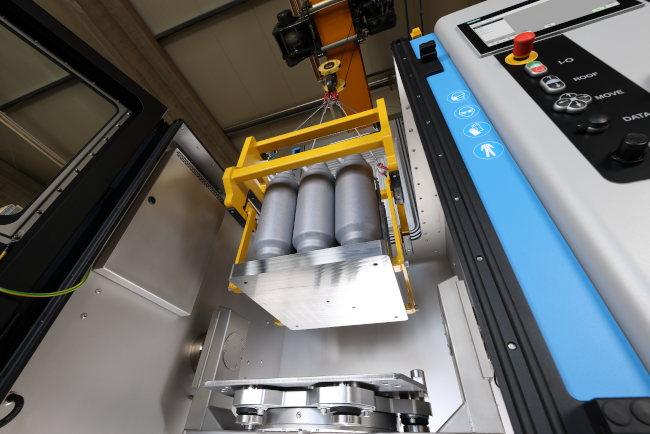
It’s now even easier to load the SFM-AT1000-S, thanks to the pneumatic top. When the top opens, it folds up together with the upper door frame, so that the part can be inserted at turntable height with even more flexibility – it’s no longer necessary to ”thread in” the part from above. This enables particularly large and heavy parts to be lifted easily and conveniently into the system via crane.
The new front-top-loading option of SFM-AT1000-S.
SPR-Pathfinder®-Software
Solukon will publicy present the brand-new software for digital depowdering at Rapid +TCT 2023. Using a transparent heat exchanger, we will demonstrate how SPR-Pathfinder® software depowders even the most complex geometries in an SFM-AT800-S.
SPR-Pathfinder® software interface.
Explore our metal depowdering systems live
We’re happy to have three metal depowdering systems on display.
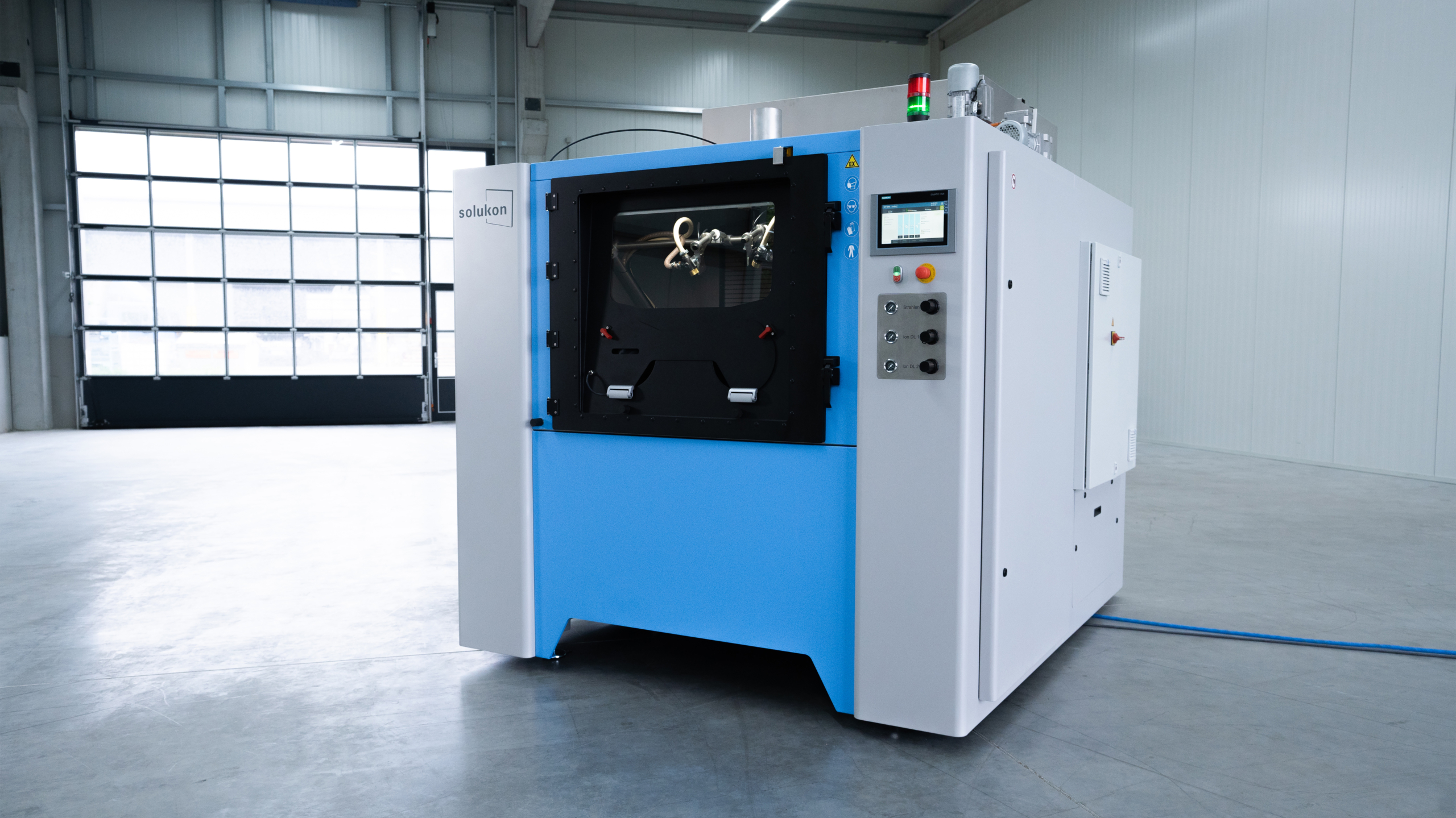
The SFM-AT350, the new standard for medium-sized parts
TheSFM-AT800-S, the award-winning flagship for complex geometries showcasing SPR-Pathfinder®
The SFM-AT1000-S in the short-arm version with front-top-loading
The Solukon team is happy to join the Additive Manufacturing User Group again.
AMUG is a global community focused on accelerating the education and advancement of additive manufacturing and 3D printing. The Additive Manufacturing Users Group (AMUG) Conference brings together engineers, designers, managers, and educators from around the world to share expertise and best-practices in additive manufacturing.
This year’s AMUG takes place in Hilton Hotel, Chicago Illinois.
Solukon will exhibit at AMUGExpo (March 19 and 20) this year. Meet our CEO, Andreas Hartmann and our Global Sales Director Michael Sattler at the Solukon booth 22 in Salon A.
The Solukon team is looking forward to discuss your depowdering application with you. See you soon!
The Solukon team is happy to reconnect with the AM community again. Here’s what to expect on booth 12.0, B21.
Presentation of SPR-Pathfinder®
Solukon will publicy present the brand-new software for digital depowdering at Formnext. Using a transparent heat exchanger, we will demonstrate how SPR-Pathfinder® software depowders even the most complex geometries in an SFM-AT800-S.
Explore our metal depowdering systems live
We’re happy to have all four metal depowdering systems on display.
The SFM-AT200, the entry-level system for medical components
The SFM-AT350, the new standard for medium-sized parts
The SFM-AT800-S, the award-winning flagship for complex geometries
The SFM-AT1000-S for extraordinary large part dimensions
Learn about our polymer powder removal system
Our SFP770 is the world’s first postprocessing system to include both an automatic unpacking station and a cleaning station for SLS components in one system. Diagrams and videos will explain the design of the SFP770.
Explore a unique case study about Depowdering in New Space
a joint presentation of Solukon and Morf3D on Tuesday, November 15, 3.40 PM
At acatech’s senate event at Siemens headquarters in Munich Solukon shows how intelligent depowdering based on the digital twin is driving the industrialization of 3D printing.
The National Academy of Science and Engineering, or acatech, an organization funded by the German federal and state governments, is the voice of the technological sciences at home and abroad. Its Senate, consisting of 105 well-known personalities from internationally leading German tech companies, held its annual meeting at Siemens headquarters in Munich. The event addressed important future topics of the industry such as sustainability of digital transformation processes or global supply chains. Another focus was the digital twin area. Here, in the so-called Real Life Experience, Siemens took the senators to use cases in which the digital twin is already being applied. One of these is the intelligent software in a Solukon SFM-AT800-S.
Algorithm-based industrial depowdering
Christoph Kiener, Principal Key Expert Functional Design for Manufacturing at Siemens, and Solukon CEO Andreas Hartmann showed the senators, how algorithm-based depowdering increases efficiency in postprocessing of additive manufacturing. Flow simulation is key for software-controlled depowdering. It analyses the geometry of the digital twin of the part to find the corresponding motion sequence within the Solukon system. Applying the algorithmic depowdering, you can clean even the most complex parts reliably and fast. For subsequent cleaning jobs you can use the motion sequence as a program.
The senators, including host Roland Busch, CEO of Siemens, experienced the performance and significance of algorithm-based depowdering.
Roland Busch, CEO of Siemens, is shown the intelligent depowdering process in a Solukon SFM-AT800-S. Image: Siemens
“Solukon’s intelligent depowdering process is one of the lighthouse projects that shows how the digital twin and artificial intelligence make a difference in the industry”, says Christoph Kiener. Kiener had developed the intelligent Solukon depowdering software in 2018. In combination with the SPR® depowdering technology, this makes Solukon the market’s sole provider of intelligent powder removal, i.e. depowdering based on an algorithm.
Christoph Kiener and Andreas Hartmann present the depowdering software to Ulrich Eichhorn (VW), Roland Busch (Siemens) and Sabine Klauke (Airbus) (from left to right). Image: Siemens
Long-standing partnership between Solukon und Siemens
Solukon has a long-standing partnership with Siemens. “Solukon is not only a customer and licensee of Siemens, but also a supplier and partner”, says Kiener. The Solukon managers were all the more pleased to be able to present Solukon technology at this high-class event. “It was an honor for Solukon to show the depowdering software as a co-innovation of Siemens and Solukon at the acatech senate event”, summarizes Solukon CEO Andreas Hartmann.
The Solukon team is happy to reconnect with the US AM community again.
It’s time for face-to-face events again. As the US AM market is a highly valued and significant one for Solukon, the machine manufacturer is delighted to exhibit at two leading US trade shows in May. The depowdering pioneer will be at Rapid + TCT in Detroit, Michigan and at Space Tech Expo in Long Beach, California.
Learn about a unique case study about Depowdering in New Space: a joint presentation of Solukon and Morf3D on May 19, 11 AM
For the first time ever, Morf3D and Solukon have jointly investigated how automated depowdering pushes the boundaries of 3D printable metal parts, paving the way to a real freedom in part design. Only if even the finest channels of a rocket engine or combustion chamber are free of powder (which is achieved through automated depowdering in the first place), components are ready for serial production and the New Space Race is on. In the presentation Michael and Franck will propose a generic use case that includes challenging features like gyroid structures, thin walls and intricate internal channels.
Right after Rapid + TCT the journey continues to California: Solukon will exhibit at Space Tech Expo in Long Beach for the first time. Space Tech Expo is the West Coast’s must-attend B2B exhibition and conference for space technology and services. Meet the Solukon team at booth 1017 and learn how automated depowdering can be a game-changer in AM for Space.
A Solukon customer survey reveals insights into the limits of manual depowdering.
In additive manufacturing steps subsequent to the build process are covered under the umbrella term postprocessing. Powder removal is the very first postprocessing step right after the printing. As a result, it has a significant influence on the quality and safety of all subsequent processes such as heat treatment, wire EDM, support removal and powder recovery.
Depowdering is the main field of Solukon, being the first to develop automated solutions to remove trapped powder from complex geometries within metal laser melted parts in 2014.
The machine manufacturer has asked 23 AM experts about the challenges of manual powder removal.
Health hazards and repeatability as main concerns in powder removal in additive manufacturing
The short survey shows that AM experts see health hazards as greatest challenge when it comes to powder removal in additive manufacturing. 78% percent of respondents therefore assess the issue of occupational health as very challenging or at least challenging. Another issue is repeatability: 74% of the AM experts find it difficult to achieve repeatable cleaning results when the powder is removed manually. This is also reflected in the fact that 70% perceive quality as an important issue.
The results of the Solukon survey on the challenges of manual powder removal.
“Occupational health and quality of cleaning results are the main concerns of our AM community”, states Andreas Hartmann, CEO and CTO of Solukon. “This is exactly what we tackle with our Smart Powder Recuperation technology. SPR® enables fully automated, scalable and repeatable cleaning of 3D printed metal parts in a protected atmosphere.”
Handling of large components within powder removal
It seems obvious that depowdering becomes more difficult the larger and thus heavier the components are. Therefore 70% of the AM experts report handling of heavy weight metal parts as a challenge. “Especially with heavy weight components manual depowdering reaches its limits. Parts weighing several hundred kilos obviously require auxiliary equipment. We offer the SFM-AT1000-S, a depowdering unit for parts weighing up to 800 kg for this challenge”, states Hartmann.
Surprisingly, the respondents perceive the challenges with regard to powder as less relevant. Only 43% respectively 35% of the AM experts rate powder recovery and disposal of powder as challenging. This could reveal that AM experts being interviewed possibly have already established successful powder handling processes.
Companies will integrate sensor-data from depowdering into end-to-end workflow
Authentise, the leader in data-driven workflow tools for additive manufacturing, and Solukon, the ground-breaking pioneer and market leader of automated depowdering systems for metal and polymer additive manufacturing, have today agreed the integration of the Solukon Digital Factory Tool into the advanced Manufacturing Execution System (aMES).
Seamless data flow to ensure overall AM process traceability
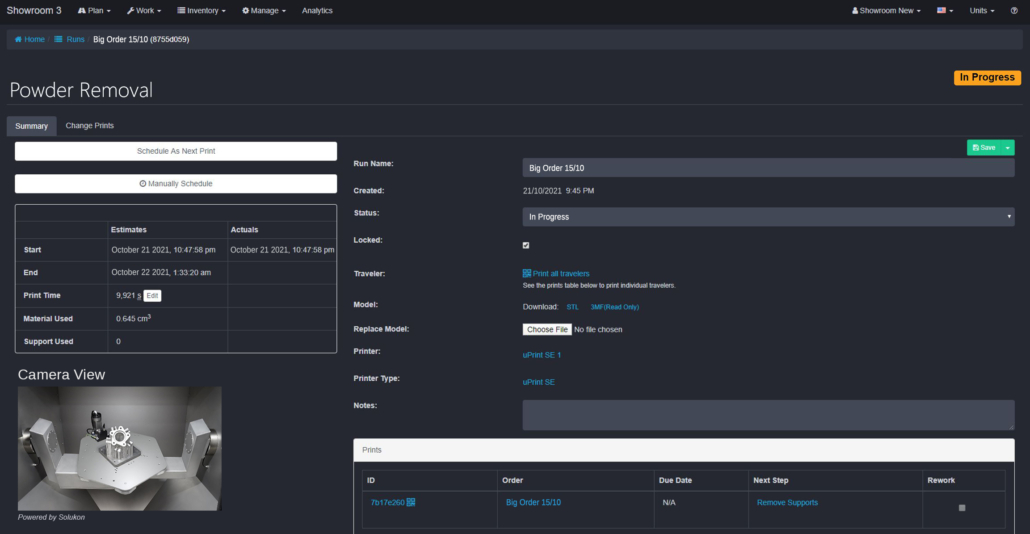
The integration of the Solukon powder removal environment will enable users to continue the powder to part genealogy using Authentise’s leading material traceability module. This will increase opportunities for improved postprocess inspection recording and recycling of recovered materials. In addition, real-time alerts generated by the Solukon system inside aMES will help the user address any deviations during the process and improve powder recovery. Since aMES already captures data from AM machines and manages the printable geometry, the system passes this information on to Solukon automatically, saving the user from locating and uploading this information separately. The insight generated is appended to the existing aMES part report to ensure end-to-end traceability. In the future, both companies aim to integrate Solukon’s automatic toolpath creation into the Authentise aMES to help users identify the optimum automated powder removal process for their specific application.
The Solukon depowdering in aMES by Authentise.
“By partnering with Authentise, we are taking the next logical step after the introduction of the Solukon Digital Factory Tool. Seamless data collection and interpretation throughout the entire production and postprocess is the only way to achieve a true production line in additive manufacturing. Together with Authentise, we are closing a gap in data transparency and open the way for real Industry 4.0 projects,” says Andreas Hartmann, CEO and CTO of Solukon.
“This is the first time that Authentise has extended its ability to communicate beyond additive devices into postprocessing equipment,” says Andre Wegner, CEO of Authentise. “The benefits are immediately obvious: higher labour and material efficiency, as well as better traceability for users. The partnership is driving near immediate Return on Investment for our users. The collaboration proves once again that customers can benefit from leaders in AM workflow joining to create tools that not only benefit the customer but make the all-important step to creating pathways to more sustainable industrial additive manufacturing.”
2021 is a year of expansion for depowdering pioneer Solukon. For a greater market reach the company has already won distribution partners for Canada, UK, Ireland and Turkey this year. Now, HDC Co. joins the team and partners with Solukon for the South Korean market in Additive Manufacturing.
Solukon is the known pioneer and technical leader of industrial powder removal systems in Additive Manufacturing. Solukon systems rely on the unique Smart Powder Recuperation technology SPR® and remove loose powder from metal laser melted parts within a sealed process chamber, using adjustable vibration and automated two-axis part rotation. Through programmable rotation of the build-plate in two axes, unfused metal build material is completely removed from complex channels and geometries. This means a significant increase in efficiency, security and quality while saving costs.
Highly experienced reseller for South Korea
HDC Co. has been in the 3D printing business since 1999 as a 3D printing bureau, a consulting service and a distributor for additive manufacturing solutions. In South Korea, HDC among others already represents German OEM EOS. Therefore, Solukon put their trust in a highly experienced AM partner.
Brian C.G. Seo, President of HDC Co. is delighted about the partnership with Solukon, “For years, HDC Co. has been working with the international leaders in the AM industry. By partnering with Solukon, we’re fortunately able to offer our customers the top-of-the-line depowdering solution, too.”
Michael Sattler, Global Sales Director at Solukon responsible for the reseller network adds, “Awareness of the need for safe and repeatable postprocessing is increasing around the world. We’re pleased to have HDC Co. as a trusted partner for the South Korean market who will meet the increased demand for automated depowdering there.”
Solukon and HDC Co. partner for the AM market in South Korea.
This year German Solukon Maschinenbau, pioneer and technical leader of automated powder removal, has started a new event series: the AM User Day. The first edition of this event was a full success with great speakers and registrations from 20 various countries.
The Solukon AM experts’ event was split in two blocks. In the morning the event took a closer look at Industrial Serial Production in AM. After a short keynote by Andreas Hartmann, CEO and CTO of Solukon, stage was open to Chris Barefoot, Head of Sales at Materials Solutions. Chris gave an insight into data driven improvement of production lines by decreasing the so-called lead time, which means the time customers have to wait until the AM product can be delivered. “Beside quality and cost, lead time is a key factor for decision making in the AM sector. Decreasing the lead time is more difficult than expected. In the end, it is all about detailed data, which are often difficult to track in between the different steps of the production line”, Chris concluded.
Automation in AM
Later on, the User Day community focused on the subject of automation in AM. “The ability to provide smart machines which can be integrated in the existing factories and the corresponding IT systems is key to the success of Additive Manufacturing”, said Rainer Salzberger, Digital Manufacturing Consultant at EOS, in his presentation about EOS Connectivity. He also presented the EOSCONNECT product landscape for connectivity which is perfectly suitable to Solukon’s Digital Factory Tool for quality assurance and automation integration. Asked after the main pain point in implementing connectivity projects in AM Rainer Salzberger concluded: “Fulfilling the requirements of the IT departments is the biggest challenge. Every new software or tool you bring into your AM facilities has to be screened for cyber security reasons and for compatibility with the existing infrastructure”, he added.
Sticking with the subject of automation Rainer Salzberger handed over to Felix Hantsch and Dr. Achim Fischer from German pneumatics specialist Festo who presented a world premier at AM User Day. Festo and Solukon actually are collaborating in a joint research project to investigate handling solutions and kinematics within a Solukon depowdering unit.
Automated depowdering processes can sometimes struggle to remove powder from component surfaces despite rotating and vibrating the component, particularly when dealing with difficult-to-handle materials like copper. Using a light and direct blow of air will dislodge these fine deposits. By blowing air through the channels, it is also possible to check that they are free of deposits. Currently this is a manual procedure that can be carried out easily at the Solukon system using glove ports. However, larger components with a height of at least 1 meter make access more difficult and this requires automated support. The joint project between Festo and Solukon to investigate handling solutions and kinematics will show how this process can be designed with maximum efficiency.
AM in the high complexity sector MedTech at AM User Day
The second half of AM User Day focused on AM in the MedTech industry. With Nicolas Bouduban, CEO of the Swiss m4m Center in Switzerland, undoubtfully a real industry expert spoke about AM technology transfer in the medical sector. “Additive Manufacturing is not only 3D printing. It’s basically the ability to link all parts of the process chain together”, explained Nicolas Bouduban. According to him, what makes the difference at the end is a global approach and understanding of quality assurance in every single step of the process. That’s why Swiss m4m Center offers services along the holistic process chain for verification or even validation of the customers’ project. In MedTech AM experts should pay particular attention to Solukon’s field of depowdering according to Nicolas. “Depowdering is the entry door for proper postprocessing activities. Without a proper depowdering process, you risk having medical parts that are not cleanable or even not certifiable at all”.
Not only theoretical knowledge was shared at AM User Day but also practical insights were given. Alexander Bauer, Application Manager at Solukon, gave a live tour through the assembly area of Solukon followed by a live depowdering within the Solukon powder removal system SFM-AT800-S. Alexander Bauer also spoke about the functionalities and part capacities of the different depowdering systems.
After seven hours of deep AM knowledge and discussion the stage was open for free table talking and networking.
During the day Solukon welcomed about 70 attendees from various nations around Europe. “We are overwhelmed by the positive outcome of our event”, shows Andreas Hartmann, CEO and CTO of Solukon, his content about the first instalment of the AM User Day. The next volume is in the pipeline, yet. “In late autumn, we will arrange the event in particular for American AM experts”, he says. The Solukon team is already looking forward to the second edition of AM User Day and for sure will be burning the midnight oil for the American AM community.
The attendees collaborated on a word cloud about the main challenges in AM.
Depowdering of rocket parts: Stoke Space trusts in Solukon’s SPR® technology
Stoke Space additively manufactures copper thrust chambers which present an exceptional depowdering challenge. Learn why they chose a Solukon SFM-AT800-S for depowdering.
Building rapidly reusable rockets, Stoke Space designs and additively manufactures copper thrust chambers which present an exceptional depowdering challenge. This is why Stoke chose the Solukon SPR® depowdering technology having acquired an SFM-AT800-S.
Stoke Space is a U.S. space launch company located in Kent, Washington, building the world’s most efficient fully and rapidly reusable rocket designed to fly daily. Stoke’s rocket will radically increase access to space opening the space economy for new and innovative technologies on orbit.
Thrust chambers with complex inner structures
Both of Stoke’s first and second stages are fully reusable. The second stage, usually thrown away in conventional space industry, is able to reenter Earth’s atmosphere and land after deploying payloads in space. To enable rapidly reusable vehicles, both of Stoke’s first and second stage engine thrust chambers are additively designed and manufactured in-house. These thrust chambers feature regenerative cooling channels and built in manifolds. These features and internal cavities are typically difficult to depowder. This is where Solukon’s depowdering technology comes into play with the SFM-AT800-S.
The Stoke rocket consists of two fully reusable stages. Credit: Stoke.
SFM-AT800-S in spotlight: the system for the biggest powder removal challenges
The SFM-AT800-S is Solukon’s flagship machine for tough depowdering challenges and is the most widely used automated powder removal system in the additive manufacturing industry. The SFM-AT800-S can handle metal parts with maximum dimensions of 600 x 600 x 600 mm (alternatively: 800 x 400 x 550) weighing up to 300 kg. Based on the unique Solukon Smart Powder Recuperation technology SPR®, the SFM-AT800-S uses targeted vibration and unlimited 2-axis rotation in a protected atmosphere to get unfused powder out of metal laser melted parts fully automatically.
The SFM-AT800-S at the Stoke facility.
High frequency knocker for copper applications
Stoke additively prints their thrust chambers using a special copper alloy with a high conductivity to enable maximum reusability. Copper powder however makes complete powder removal more challenging due to its tendency to stick and clump within the tight regen channels. Stoke uses a high frequency knocker provided as an add-on in the Solukon system to loosen trapped copper powder bulks from internal channels of the parts. Stoke also applies an ultrasonic vibration system to enhance the flow of the copper powder, which is directly connected to the component.
For complex geometries there’s another way to optimize depowdering even further – by analyzing the CAD file of the part. The unique Solukon depowdering software SPR-Pathfinder® does so: It works with a digital twin of the part and calculates the motion pattern for the Solukon system automatically to get the powder out of the complex structures. “SPR-Pathfinder® is a convenient tool to optimize the depowdering before it even started,” said Andreas Hartmann, CEO and CTO of Solukon.
Solukon is the proud depowdering partner of choice for Stoke. “We chose Solukon for their industry leading capability in automating depowdering of complex parts,” said Zach Sander, Head of Engine and Fluid Systems at Stoke Space. “Regeneratively cooled rocket engine thrust chambers are notoriously difficult to depowder, and we wanted to ensure we had a robust machine to reliably depowder these difficult copper components.”
You are currently viewing a placeholder content from Turnstile. To access the actual content, click the button below. Please note that doing so will share data with third-party providers.