NEWS

Solukon launches Digital Factory Tool for Quality Assurance and Automation Integration

The Solukon Digital Factory Tool allows an easy integration of automated powder removal into an overall digital AM process.

March 22 2021

Augsburg – Since launching the market`s first automated depowdering system, the SFM-AT800 in 2015, Solukon is the known pioneer and expert for powder removal.


Being pioneer in the field of postprocessing means taking into account other steps of the process chain in Additive Manufacturing, too. Therefore, Solukon has fine-tuned a sensor concept and launched an interface management concept in order to fit Solukon depowdering systems into a holistic AM process chain. The Digital Factory Tool is an exemplary and crucial step towards fully integrated automation and quality assurance in Additive Manufacturing.

The Solukon Digital Factory Tool allows an easy integration of automated powder removal into an overall digital AM process.

The tool includes:

  • production control
  • maintenance management
  • integration of automation and
  • process validation / quality management.

Production control

Since 2017 Solukon has equipped the SFM-AT800 with an OPC UA interface to enable central controlling and monitoring.

Like at Fraunhofer Institute for Machine Tools and Forming Technology (IWU) located in Dresden, Germany, where a Solukon SFM-AT800 with an OPC UA interface is part of a modular robot cell. This fully automatic robot cell serves as a characteristic example for downstream processing: Besides the Solukon depowdering unit the robot cell consists of a system for optical analytics of the geometry and a system for support removal. The different stations communicate via OPC UA.

The Solukon system in a modular robot cell at Fraunhofer IWU. Credit and copyright: Studio36 Berlin.

The rise of Additive Manufacturing in industries like Aerospace brought up factory lines consisting of a variety of 3D printers and peripheral equipment. 

All of these devices are covered in one central control station. This is where production managers are able to monitor and control the machines. Therefore, both upstream and downstream processes like set-up effort, unpacking, depowdering and sieving can be connected and monitored in real time – regardless of the printing job itself.

In order to ensure efficiency in production planning one major focus should lie in production coordination. The machine data collection supplies data concerning operating time and shutdowns and therefore essential information with regard to overall equipment effectiveness (OEE) for further production planning. For planning, the operator is usually using apps, wherein data is collated and summarized in dashboards. Afterwards the operator may consider a planning software for evaluation.

The Solukon OPC UA interface allows both access to machine data and remote control. In addition, the Solukon Digital Factory Tool enables the operator to integrate all information into the dashboard of the machinery app. Data and parameters referring to cleaning programs, such as running time and batch number, can easily be assigned via the network. Regarding the cleaning process the OPC UA interface enables the operator to start, monitor and modify the cleaning program as desired. Machine state and process progress are accessible in real time.

Maintenance management

Solukon’s new sensor system monitors all sensitive machine components and processes referring to lifetime of the machine.

The operator therefore can immediately recognize unwanted changes in consumption of inert gas, compressed air, chamber atmosphere or energy to get an overview about the performance of the individual machine components. Moreover, the system informs the operator in time, when maintenance is required or when to procure wear parts. Upon request, Solukon sets up an interface for remote maintenance and diagnosis.

Integration of automation

Flagship projects like HyProCell and NextGenAm issue an outlook how automated AM-production works. Integration of downstream processes in particular will play an increasingly important role.

At HyProCell, Solukon has already proven his competence in automation integration:

The Solukon system SFM-AT800 is constantly communicating with a control center while being loaded by a robot. For this purpose, the SFM-AT800 has been equipped with a special loading door and an automatic clamping system.

“The Solukon system is the first unit right after the building process and is therefore essential for further steps of the automated process chain. With the Hyprocell project, Solukon impressively displayed their high automation potential. Therefore, Solukon systems are ideally suited for further automation projects”, states Dr. Juan Carlos Pereira Falcon, Senior Researcher at Lortek and coordinator of the HyProCell project.

Process Validation and Quality Management

The extended quality feature is obviously the key element of the Solukon Digital Factory Tool.
Certification is a big but mandatory challenge for manufacturers of sensitive industries like Medical or Aerospace. Each step of production is supposed to be clearly reproducible. The more process data is recorded and logged, the easier the certification.
The Solukon Digital Factory Tool provides a fine-tuned sensor package to record relevant conditions in the process chamber, such as residual oxygen, humidity, pressure, temperature and frequency of the vibrator, in a protocol file for quality assurance. Effective evaluation of the recorded data helps validating the process in an overall quality certificate and simplifies process optimization. The operator may set limits to sensible values in advance so that deviations are noticed and considered immediately and quality defects are avoided in time. Beside process data even information referring to the cleaning program itself are recorded automatically.

To create a certification document for each project, the user has the opportunity to fill out a large and individual composable input mask. 

The user then can collect data referring to his build job in a flexible dialog box. This includes for example type, batch and used material. In the end, the user is provided a final protocol as PDF- CSV or XML-file to be stored central or printed on paper.

In summary the Solukon Digital Factory Tool raises quality management to the highest level: It provides continuous documentation and real time monitoring. In this way the complete process step is fully recorded and can be resubmitted for proof of quality. Problems and quality deficiencies can easily be identified in time and their cause revealed.

„The Solukon Digital Factory Tool marks a significant step towards automation in postprocessing and therefore towards integration into a holistic AM process chain. Especially through process validation in one comprehensive protocol our customers achieve an even faster, more accurate and easier certification. The Solukon Digital Factory Tool is especially applicable to sensitive industries like Aerospace and Medical”, says Alexander Bauer, Application Manager at Solukon.

Solukon will offer the Digital Factory Tool as a new option for the SFM-AT800 and the SFM-AT1000-S. Existing SFM-AT800-S systems can also be retrofitted upon request. Solukon is currently cooperating with two leading manufacturers concerning process integration. Results of these projects will be presented soon.
NEWS

Depowdering of intricate channels: Solukon adds new features to their automated powder removal units

Solukon launches upgrades of their flagships SFM-AT1000-S and the award winning SFM-AT800-S.

February 18 2021

Since launching the market`s first automated depowdering system, SFM-AT800 in 2015, Solukon is the known pioneer and expert for powder removal. By equipping two depowdering units with new features Solukon directly responds to the (aerospace) market needs of handling even larger and more complex components.


Solukon launches upgrades of their flagships SFM-AT1000-S and the award winning SFM-AT800-S. Both systems are based on Solukon’s unique SPR® (Smart Powder Recuperation) process, removing residual powder from complex metal parts by unlimited and programmable part rotation and controlled vibration in a safety-controlled atmosphere.

Powder removal for large components

Both systems are reinforced to handle parts with larger dimensions. The SFM-AT800-S from now on may handle parts with a size up to 600 x 600 x 600 mm³ (XYZ) and a weight of 300 kg. The SFM-AT1000-S, an advancement of the 800-S-system and a special version particularly designed for large parts, now allows to move parts with a size up to 600 x 600 x 1.000 mm³ (XYZ) and with a weight up to 800 kg easily.

Martin Bullemer, Managing Director of AMCM GmbH, is more than satisfied with the performance of Solukon’s SFM-AT1000-S: “I am excited about the quick turnaround on the need for larger depowdering volumes. The Solukon offering makes an end-to-end solution for large components possible in the first place”. AMCM’s printer M4K was one of the first ones especially equipped for extraordinary high parts, such as rocket engines. Naturally, Solukon directly replied to AMCM’s need for a compatible depowdering unit for such extraordinary part dimensions by developing the SFM-AT1000-S.

Joystick for intuitive machine control


In addition, a main customers’ need was not only to implement larger parts but also to improve and individualize controlling. Therefore, both systems are now equipped with remote gimbal control in the form of a joystick. By using this device, the part can easily be moved along any imaginal path with variable speed. The moving path and speed can be recorded simultaneously and can later be used as an automatic program for serial cleaning.

Like in the already established versions the systems are also able to save single positions. As provided before each position can later be manually optimized in the software and assigned by intelligent functions like waiting time, vibrating, knocking and custom-made options, like programmable blowing nozzles.

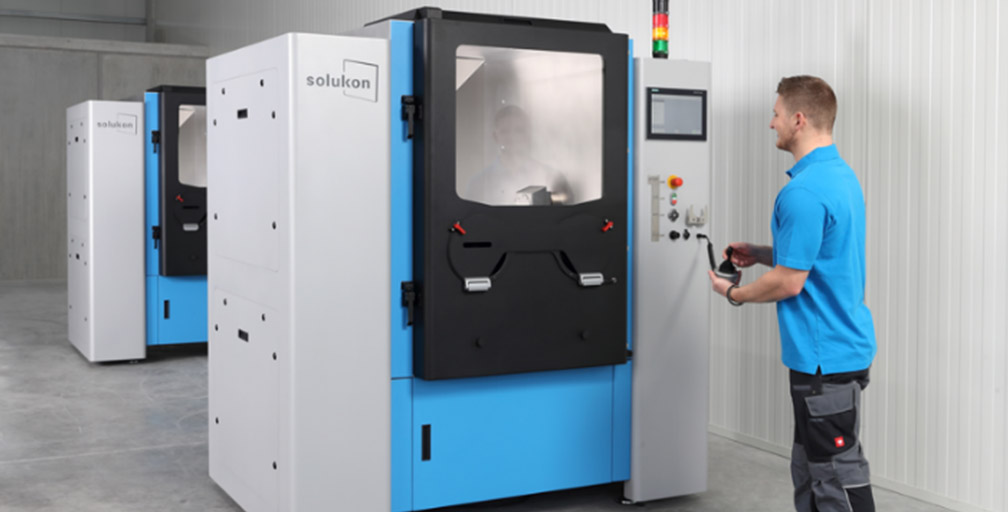
The new feature, a joystick, here used at SFM-AT-1000-S, enables the operator to move the part in any desired position.


Impactor system for breaking up clogged powder bulks

Facing more and more though to handle powders like copper, Solukon reacted with a third new feature: it adapted an additional impactor system for breaking up clogged powder bulks. So far, the Solukon’s SPR® technology provides high frequent vibration to ensure a fluidization of the powder. Fluidization in this context means to make the powder as flowable that it can flow out of the finest channels and crevices. Materials like copper and aluminum show very sticky behavior and tend to clog in cavities.

The impactor treats the part with finely tunable knocks to loosen the clogging.
The combination of Solukon’s proven vibration system and the new impactor ensures best depowdering results even with tough-to-handle materials. The impactor from now on is available as an additional option for all Solukon systems.

Andreas Hartmann, as co-founder in charge of system development, is proud having responded directly to the market needs: “Taking a closer look at the market, we clearly see a development to larger parts with highly complicated internal geometries as well as a trend for tough-to-handle materials. Especially rocket engineering is a leading force here brilliantly designing with copper. With our latest adjustments we want to give our customers even more opportunities to achieve their goals efficiently and comfortably.” Hartmann also outlines the strategy for 2021: “Listening to our customers and continuous improvement of our systems have always been our guiding principle. During this year we are planning to come up with new retrofittable add-ons for our customers”.

Andreas Hartmann, CEO und Entwicklungsleiter
NEWS

Depowdering of rocket parts: Stoke Space trusts in Solukon’s SPR® technology

Stoke Space additively manufactures copper thrust chambers which present an exceptional depowdering challenge. Learn why they chose a Solukon SFM-AT800-S for depowdering.

January 1 1970

Building rapidly reusable rockets, Stoke Space designs and additively manufactures copper thrust chambers which present an exceptional depowdering challenge. This is why Stoke chose the Solukon SPR® depowdering technology having acquired an SFM-AT800-S.


Stoke Space is a U.S. space launch company located in Kent, Washington, building the world’s most efficient fully and rapidly reusable rocket designed to fly daily. Stoke’s rocket will radically increase access to space opening the space economy for new and innovative technologies on orbit.

Thrust chambers with complex inner structures

Both of Stoke’s first and second stages are fully reusable. The second stage, usually thrown away in conventional space industry, is able to reenter Earth’s atmosphere and land after deploying payloads in space. To enable rapidly reusable vehicles, both of Stoke’s first and second stage engine thrust chambers are additively designed and manufactured in-house. These thrust chambers feature regenerative cooling channels and built in manifolds. These features and internal cavities are typically difficult to depowder. This is where Solukon’s depowdering technology comes into play with the SFM-AT800-S.

The Stoke rocket consists of two fully reusable stages. Credit: Stoke.

SFM-AT800-S in spotlight: the system for the biggest powder removal challenges

The SFM-AT800-S is Solukon’s flagship machine for tough depowdering challenges and is the most widely used automated powder removal system in the additive manufacturing industry. The SFM-AT800-S can handle metal parts with maximum dimensions of 600 x 600 x 600 mm (alternatively: 800 x 400 x 550) weighing up to 300 kg. Based on the unique Solukon Smart Powder Recuperation technology SPR®, the SFM-AT800-S uses targeted vibration and unlimited 2-axis rotation in a protected atmosphere to get unfused powder out of metal laser melted parts fully automatically.

The SFM-AT800-S at the Stoke facility.

High frequency knocker for copper applications

Stoke additively prints their thrust chambers using a special copper alloy with a high conductivity to enable maximum reusability. Copper powder however makes complete powder removal more challenging due to its tendency to stick and clump within the tight regen channels. Stoke uses a high frequency knocker provided as an add-on in the Solukon system to loosen trapped copper powder bulks from internal channels of the parts. Stoke also applies an ultrasonic vibration system to enhance the flow of the copper powder, which is directly connected to the component.

For complex geometries there’s another way to optimize depowdering even further – by analyzing the CAD file of the part. The unique Solukon depowdering software SPR-Pathfinder® does so: It works with a digital twin of the part and calculates the motion pattern for the Solukon system automatically to get the powder out of the complex structures. “SPR-Pathfinder® is a convenient tool to optimize the depowdering before it even started,” said Andreas Hartmann, CEO and CTO of Solukon.

Solukon is the proud depowdering partner of choice for Stoke. “We chose Solukon for their industry leading capability in automating depowdering of complex parts,” said Zach Sander, Head of Engine and Fluid Systems at Stoke Space. “Regeneratively cooled rocket engine thrust chambers are notoriously difficult to depowder, and we wanted to ensure we had a robust machine to reliably depowder these difficult copper components.”

Stoke engine hot-fire test. Credit: Stoke

FORMNEXT 2025

What to expect
Booth 12.0 – D71

0 DAYS
0 HRS
0 MIN