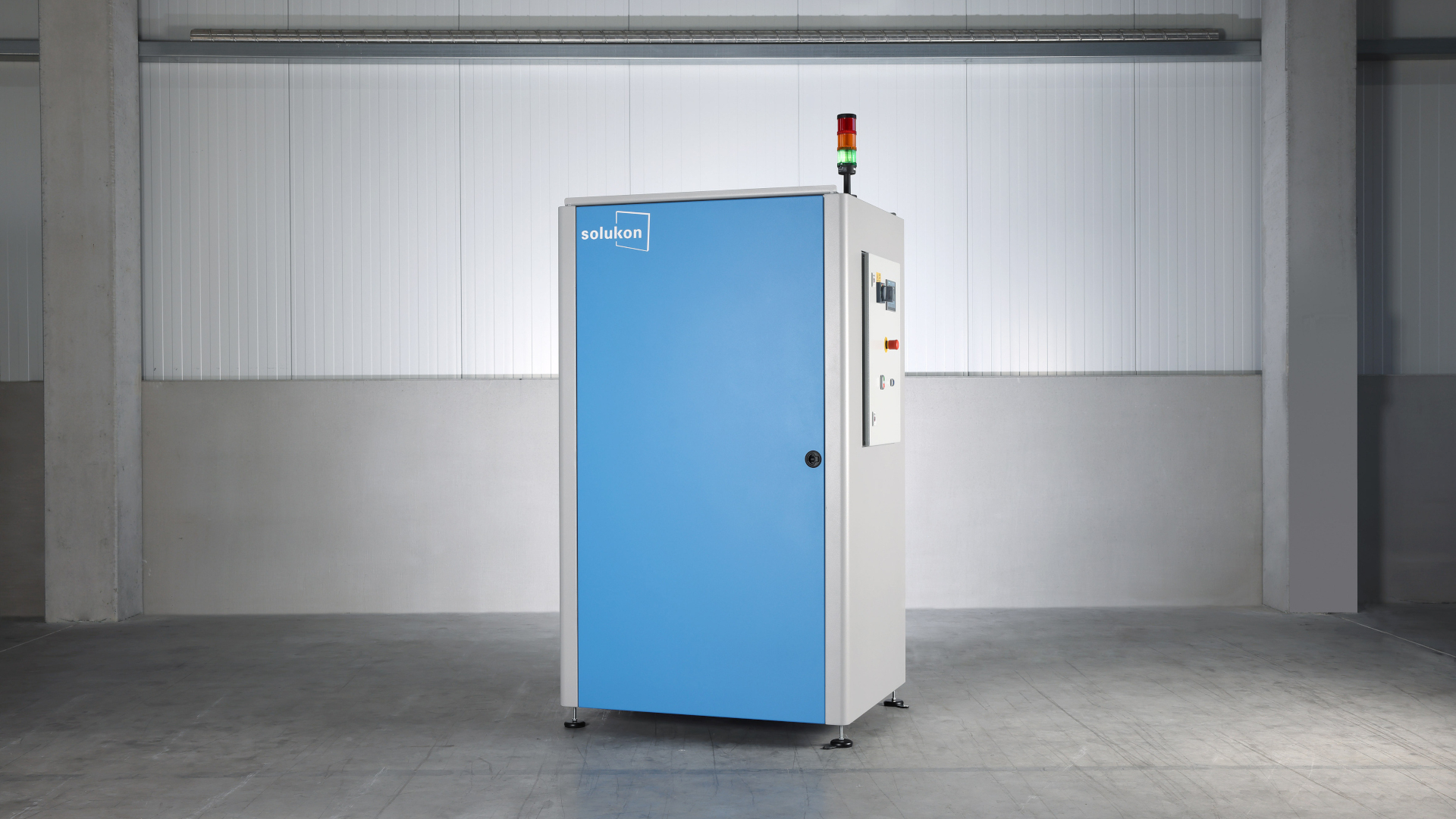
The Solukon team is happy to reconnect with the US AM community again – this year in Los Angeles, California. Here’s what to expect at booth 2161.
Enhanced Depowdering System SFM-AT350
Thanks to its adapted arm design, the SFM-AT350/-E can now accommodate parts weighing up to 100 kg as well as plates of the flagship printersEOS M 400 and Nikon SLM® 500. Also, you’ll have the chance to view the E-version of the SFM-AT350: The first and only depowdering system with ultrasonic excitation for the cleaning of sensitive structures.
What else is at display?
Beside the SFM-AT350/-E you’ll have the chance to see the SFM-AT1000-S live and in color. It’s maximum capacity of 800 kg and the flexible front-top loading makes it THE depowdering system for aerospace.
SPR-Pathfinder®-Software Discount Campaign
The newest version of our unique depowdering software SPR-Pathfinder® introduces several thrilling enhancements like a pre-simulation of the powder removal process or an optional pre-cleaning.
The new software version marks a milestone for us we want to celebrate with you. As a token of appreciation for your continued support, we’re offering an exclusive discount campaign for our cutting-edge SPR-Pathfinder® Software.
Learn more via a separate mailing or directly at our booth 2161.
See you soon in Los Angeles, California, Home of a range of space companies and our Mission Patches!
Serial cleaning of complex parts: MT Aerospace trusts in Solukon
Leading international aerospace company MT Aerospace is investing in intelligent and automated postprocessing of 3D-printed components with a Solukon SFM-AT800-S.
Leading international aerospace company MT Aerospace is investing in intelligent and automated postprocessing of 3D-printed components with a Solukon SFM-AT800-S.
MT Aerospace, an OHB company, has had an additive manufacturing division at its headquarters in Augsburg since 2017 and produces highly complex components for the aerospace industry and other leading sectors. The company can map the entire value chain of all necessary process steps: from development and production to finishing, assembly and qualification.
High precission in production and postprocessing
Increasing demands on production have led, among other things, to the decision in favor of Solukon as a partner for automated depowdering: “In the production of series parts for the aerospace industry, we sometimes have to deal with tolerances of just a few microns (µ). Logically, maximum precision is also required for the postprocessing of these highly complex components,” says Markus Axtner, Senior Vice President and Head Program Additive Manufacturing at MT Aerospace.
With the Solukon SFM-AT800-S, MT Aerospace has acquired the flagship among powder removal solutions. It can be used to remove powder from the most complex components with maximum dimensions of 600 x 600 x 600 mm (alternatively: 800 x 400 x 550 mm) and a maximum weight of 300 kg fully automatically and efficiently. The postprocessing system is based on the unique Solukon Smart Powder Recuperation technology SPR®. The optional Digital-Factory-Tool, a sensor and interface kit, makes the entire depowdering process transparent by tracking all relevant depowdering data and summarizing it in a log.
The SFM-AT800-S is also compatible with the unique SPR-Pathfinder® software. It can be used to automatically calculate individual movement patterns for each component based on the component’s CAD file. Markus Axtner explains why this is a decisive factor when depowdering series orders in the following video.
You are currently viewing a placeholder content from YouTube. To access the actual content, click the button below. Please note that doing so will share data with third-party providers.
Thanks to its adapted arm design, the SFM-AT350/-E can now accommodate parts weighing up to 100 kg as well as plates of the flagship printers EOS M 400 and Nikon SLM® 500.
Thanks to its adapted arm design, the SFM-AT350/-E can now accommodate parts weighing up to 100 kg as well as plates of the flagship printers EOS M 400 and Nikon SLM® 500. For the first time, at Rapid + TCT in Los Angeles, the upgraded depowdering system can be viewed live.
With the exception of parts for the medical sector, which tend to be small and stout and often have lattice structures, there is a clear trend in the medium-sized part segment: the total weight of LPBF parts has increased. One reason for this is that the parts are usually produced on solid build plates, sometimes with numerous complex support structures. As an immediate downstream process, depowdering must grow hand in hand with printing. This is why Solukon has upgraded its SFM-AT350 depowdering system, which is leading the market.
In the future, the SFM-AT350 will be able to accommodate parts with a total weight of up to 100 kg and dimensions of 400 x 400 x 400 or 500 x 280 x 400 mm. The SFM-AT350 was originally designed only for parts weighing up to 60 kilograms and was only compatible with parts measuring a maximum of 350 mm on the X-axis. The increase in total permitted weight is achieved exclusively through an adapted arm design, which means that the chamber volume and the associated inert gas consumption remain the same. With this upgrade, Solukon has also increased the compatibility of its system. “Many of our current and potential customers print their medium-sized parts on an M 400 from EOS or a Nikon SLM® 500. The upgraded SFM-AT350 is now compatible with both of these printers and therefore covers two more key additive manufacturing systems in this size range,” said CEO/CTO Andreas Hartmann from Solukon. The new version of the SFM-AT350 offers customers with larger, highly complex components, such as in the aerospace or medical sectors, an ideal depowdering system at an optimum price-performance ratio. For parts with the dimensions mentioned above and weights higher than 100 kilograms, the next larger depowdering system, the SFM-AT800-S, is the ideal peripheral device.
SFM-AT350: The best-selling depowdering system for the middle size class
Since its launch in October 2021, the SFM-AT350 from Solukon has established itself in the global market as the ideal system for medium-sized parts and is currently used in 17 countries.
The system features a compact design in conjunction with generous freedom of movement and unique digital functions. With the SPR-Pathfinder® software, the ideal motion sequence can be automatically calculated in advance based on the part’s CAD file: no programming is required with the SFM-AT350. The optional Digital-Factory-Tool is a sensor and interface kit that tracks all the key data on the depowdering operation and summarizes it in a protocol file to ensure maximum transparency.
“These smart features have also become a must in the medium-sized part segment since the parts and support structures are becoming more and more complex here too. We are pleased that we were able to launch two sophisticated digital tools on the market so early with the DFT and SPR-Pathfinder® software and have once again demonstrated our innovative strength. The aim of the latest upgrade is to offer users with larger components weighing up to 100 kg a cost-optimized solution without compromising on functionality. No other system in this segment offers so many equipment options and functionality and closes an important gap in the growing price pressure in the service sector,” explains Andreas Hartmann.
Two excitation options available
As of October 2023, the SFM-AT350 is also available in two excitation variants. The SFM-AT350 has adjustable pneumatic vibration with the option of adding a knocker. As an alternative, the SFM-AT350-E can come with piezoelectric excitation, which cleans parts very gently by using very high, self-regulating ultrasonic vibration.
Upgrade available now – see live at Rapid + TCT 2024
The upgrade and the increased total permitted weight of parts now apply to both variants of the SFM-AT350. The upgraded SFM-AT350-E can be seen live at Rapid 2024 in Los Angeles at the Solukon Booth 2161. For the first time, Solukon will present the variant with ultrasonic excitation to the US market. The Solukon team looks forward to welcoming you!
Further highlights at the Solukon Booth 2161
Since this year’s Rapid + TCT is taking place in Los Angeles, the home of the top aerospace companies, Solukon is also exhibiting the depowdering system for industrial-scale rocket parts: the SFM-AT1000-S with flexible front-top loading. For the one-of-a-kind SPR-Pathfinder® software, there will also be a discount campaign for existing and new customers. More information will follow shortly.
Use case story edited by 3D ADEPT MEDIA investigates the new ultrasonic excitation form in the SFM-AT350-E.
Solukon’s core expertise remains automated depowdering for AM. For this article, the depowdering test was performed on the company’s latest system – the SFM-AT350-E for medium-sized parts up to 60 kg– in collaboration with the Swiss m4m Center, a technology transfer center that leverages AM for the medical and dental industries. As an advocate for AM technologies, we have been following Swiss m4m’s journey with AM since its beginning.
Key insights into a depowdering test with a build plate of medical 3D printed parts
Once you’ve decided that an automated depowdering machine is the right device for your (medical) 3D printed parts, the next step can be quite stressful: making the right decision when it comes to purchasing a machine that will ensure your products and personnel safety, reduce the risk of product failures and most importantly comply with industry standards. That’s the reason why, in another article, we discussed the must-have technical features in an automated powder removal system. The thing is, the more the market advances, the more new features are being developed and the more customers’ requirements become complex and stringent. At this point, a holistic experience that comes from a depowdering test might help tilt the balance in favor of one machine or another and confirm certification for use in a given industry or for a given application. To understand how such a test is being performed, we asked Solukon Maschinenbau GmbHsomething unusual: share insights into a depowdering test performed for one of their customers active in the medical and healthcare industries.
Insights into the brand-new SFM-AT350-E & applications at the heart of the test
Designed for metal 3D printed parts, the SFM-AT 350-E is a special version of the automated depowdering machine SFM-AT350. Unveiled last year at Formnext 2023, the new machine comes with three key upgrades: full compatibility with intelligent SPR-Pathfinder® depowdering software, enhanced functions of the Digital-Factory-Tool as well as piezoelectric excitation. If the SPR-Pathfinder® depowdering software and the Digital Factory Tool are now well-known features of Solukon’s depowdering systems and also available for the standard SFM-AT350 machine, the piezoelectric excitation tool remains intriguing for most users as a unique and special solution in the field. During the launch, Solukon explained that excitation originates directly at the rotary table of the automated depowdering system which enables the part to be shifted to the optimal vibration range with high precision. The high frequencies of the electronic excitation are considerably higher than the harmful natural frequency of the part. As the frequency constantly controls and regulates itself, the risk of exciting the resonance frequency and damaging sensitive structures is avoided. The test was performed with several medical 3D printed parts provided by Swiss m4m: hip cups, spinal cages and medical instruments. “Hip cups are a very typical application. The characteristic lattice structures allow tissue ingrowth. Also, the spinal cages for stiffening the spine in cases of instability (e.g. herniated disc). The medical instruments are used as prototypes for wet room testing. Their complex support structures with lots of long tight channels are the most difficult to depowder,” Marco Flury, Project Manager at Swiss m4M explains. As you will see below, Swiss m4m provided Solukon with different data on these parts. Overall, the test enabled to identify specific considerations that should be taken into account for these applications as well as key specifications related to the piezoelectric excitation tool.
The SFM-AT350-E with piezoelectric excitation.
The depowdering test: 6 key steps
According to Hemank Raj, Process Development Engineer at Solukon, the depowdering test requires to assess machine data, component data, visual control prior to cleaning, perform the cleaning procedure, assess the cleaning results and ensure a visual control after the cleaning step.
1. As far as machine data are concerned, it’s important to note that the alloy used during the test is not classified as reactive. The process was carried out in a non-inert atmosphere.
2. As for the component data, Swiss m4m shared information related to the measurements of the parts (W x D x H), buildplate, buildplate thickness, weight (including buildplate), hole pattern, and material. Figures translate into this:
Component measurements
Ø60mm hip cups with lattice structures (0.3-0.9mm pore size)
23 x10 x10 mm spinal cages (0.3-0.9mm poresize)
The tallest parts are medical instruments approx. 70mm in Z-height with support structures of intricate structure (smallest diameter <1 mm)
Buildplate
Round buildpalte; TruPrint 2000
Diameter 204 mm
Thickness 23 mm
Weight incl. buildplate
Approx. 13 kg
Material
Stainless Steel 17-4 PH
Legend: The most complex parts for depowdering are the areas indicated on the picture above.
3. The visual control revealed there was no visual damage, and no powder lumps on the build plate which means the material can withstand moisture absorption. However, the structures of the parts seemed to be entirely filled with powder.
4. During the cleaning phase, the build plate was mounted on the rotating plate using four clamps. Each part of this process was well timed and lasts approx. 17,5 minutes – from part loading, cleaning in automatic mode, cleaning part using air gun, checking cleaning results to part unloading. For those who are familiar with a depowdering process based on pneumatic excitation, it’s important to note that the cleaning steps are similar with those conducted in a depowdering process based on ultrasonic. Raj drew our attention to one key advantage though: “You do not have to set any excitation parameters because the depowdering system automatically sets the best excitation (= self-regulating frequency). In addition, the process was conducted in a volume maximum of 53.6 dB (for reference: a normal conversation = 60 dB) which is very silent. The process in ultrasonic excitation comes with a minimum compressed air consumption.” (That being said, in terms of technology features, a depowdering process based on pneumatic excitation comes with a programmable high-frequency knocker to dissolve powder clumps and the SPR-technology integrates a combination of rotation and vibration).
As explained above, the test confirmed that the piezoelectric excitation tool excites the 3D-printed part at an ultrahigh frequency. According to Raj, this acceleration is enormous while the amplitude is minimal. Due to the acceleration at this frequency, the powder loses its adhesion (literally the “ground under its feet”) and slides off the surface. The team realized that the SFM-AT350-E has proven to be the ideal depowdering candidate for delicate and fragile structures. Not to mention that with the “Digital-Factory-Tool we have access to all relevant depowdering data (e.g. temperature in the machine chamber, humidity and all customer specified presets) – crucial for data-sensitive industries like MedTech”, Raj adds.
5. After the cleaning phase, the team checked the cleaning results by visual control and by blowing into the opening of the parts with compressed air. Not only did they not find any powder residues in the complex structures, but the powder covering the component’s surface was removed by blowing. However, to avoid any potential minor powder residues that may have been left inside the complex structures, they recommend conducting a final cleaning (ultrasonic cleaning) before using the 3D-printed part or before the next step of the manufacturing process. In total, Flury from Swiss m4m recollected 977 grams of powderfrom this testing.
6. Lastly, with the visual inspection, no damages and no powder resting were found. All parts were still well attached to the substrate plate.
Marco Flury, Project Manager at Swiss m4M and Hemank Raj, Process Development Engineer at Solukon
Concluding thoughts
First and foremost, it’s crucial to keep in mind that the time and figures outlined in this article are only meant for the depowdering process of medical 3D printed parts performed as part of this test. This means that operators should be mindful of the component data and specifications of each 3D-printed part they will have to depowder. In the end, although the SFM-AT350-E and its piezoelectric excitation tool have proven advantages compared to conventional depowdering with pneumatic excitation, a few nuances can be observed for 3D-printed parts produced in other industries or for other medical applications. As Raj notes for instance, “compared to pneumatic excitation with a turbine or knocker, the acceleration and frequency are many times higher and the amplitude much lower. (This is why you do not see any vibration/movement of the component during excitation). The excitation frequency is between 30 kHz and 38 kHz. This means that we are far beyond the natural frequencies of the components. This prevents oscillation and damage at the resonance frequency.”
Between its ability to ensure a low-noise depowdering process, its self-regulating excitation mode and minimized compressed air consumption, this test reveals advantages that play to the strengths of this automated depowdering machine when it comes to its certification for a medical production environment. Not to mention that, even though the Digital-Factory-Tool and the SPR-Pathfinder® Software are optional tools, they remain interesting to make the most out of this machine. “With specially developed technology, we were able to set up endless rotation of the turntable in the SFM-AT350-E and thus enabled the unlimited use of the SPR-Pathfinder software”, says Andreas Hartmann, CEO/CTO at Solukon.
Overall, “the results suggest that the process works similarly well with titanium alloys. The excitation form of the SFM-AT350-E is ideal for this type of sensitive components. The cleaning process is very short and you can achieve a very high cycle rate since one single cleaning is completed in under 7.5 minutes. If we assume that loading and unloading together take 10 minutes, then you could aim for four cleaning jobs per hour with one depowdering system (given that no inert atmosphere is required where inerting time and door holding time need to be considered)”, Raj concludes. A
Marco Flury – Project Manager at Swiss m4M Hemank Raj – Process Development Engineer at Solukon.
Depowdering of rocket parts: Stoke Space trusts in Solukon’s SPR® technology
Stoke Space additively manufactures copper thrust chambers which present an exceptional depowdering challenge. Learn why they chose a Solukon SFM-AT800-S for depowdering.
Building rapidly reusable rockets, Stoke Space designs and additively manufactures copper thrust chambers which present an exceptional depowdering challenge. This is why Stoke chose the Solukon SPR® depowdering technology having acquired an SFM-AT800-S.
Stoke Space is a U.S. space launch company located in Kent, Washington, building the world’s most efficient fully and rapidly reusable rocket designed to fly daily. Stoke’s rocket will radically increase access to space opening the space economy for new and innovative technologies on orbit.
Thrust chambers with complex inner structures
Both of Stoke’s first and second stages are fully reusable. The second stage, usually thrown away in conventional space industry, is able to reenter Earth’s atmosphere and land after deploying payloads in space. To enable rapidly reusable vehicles, both of Stoke’s first and second stage engine thrust chambers are additively designed and manufactured in-house. These thrust chambers feature regenerative cooling channels and built in manifolds. These features and internal cavities are typically difficult to depowder. This is where Solukon’s depowdering technology comes into play with the SFM-AT800-S.
The Stoke rocket consists of two fully reusable stages. Credit: Stoke.
SFM-AT800-S in spotlight: the system for the biggest powder removal challenges
The SFM-AT800-S is Solukon’s flagship machine for tough depowdering challenges and is the most widely used automated powder removal system in the additive manufacturing industry. The SFM-AT800-S can handle metal parts with maximum dimensions of 600 x 600 x 600 mm (alternatively: 800 x 400 x 550) weighing up to 300 kg. Based on the unique Solukon Smart Powder Recuperation technology SPR®, the SFM-AT800-S uses targeted vibration and unlimited 2-axis rotation in a protected atmosphere to get unfused powder out of metal laser melted parts fully automatically.
The SFM-AT800-S at the Stoke facility.
High frequency knocker for copper applications
Stoke additively prints their thrust chambers using a special copper alloy with a high conductivity to enable maximum reusability. Copper powder however makes complete powder removal more challenging due to its tendency to stick and clump within the tight regen channels. Stoke uses a high frequency knocker provided as an add-on in the Solukon system to loosen trapped copper powder bulks from internal channels of the parts. Stoke also applies an ultrasonic vibration system to enhance the flow of the copper powder, which is directly connected to the component.
For complex geometries there’s another way to optimize depowdering even further – by analyzing the CAD file of the part. The unique Solukon depowdering software SPR-Pathfinder® does so: It works with a digital twin of the part and calculates the motion pattern for the Solukon system automatically to get the powder out of the complex structures. “SPR-Pathfinder® is a convenient tool to optimize the depowdering before it even started,” said Andreas Hartmann, CEO and CTO of Solukon.
Solukon is the proud depowdering partner of choice for Stoke. “We chose Solukon for their industry leading capability in automating depowdering of complex parts,” said Zach Sander, Head of Engine and Fluid Systems at Stoke Space. “Regeneratively cooled rocket engine thrust chambers are notoriously difficult to depowder, and we wanted to ensure we had a robust machine to reliably depowder these difficult copper components.”
New standards in the cleaning and post-processing of 3D-printed metal components: With the SFM-AT1000-S from Solukon, the Austrian 3D printing pioneer frees internal channels and cavities of the most complex parts from powder residues. The system recently went into operation at the company’s headquarters in Austria.
The next step for M&H towards becoming one of the Central European innovation leaders in the field of additive manufacturing: With the SFM-AT1000-S depowdering system from the German quality manufacturer Solukon, the Styria-based 3D printing pioneer is setting the next qualitative exclamation mark. The automatic powder removal system is specially designed for cleaning and post-processing 3D-printed parts. In particular, large and heavy metal components with a height of up to 1,000 mm and a maximum weight of 800 kg as well as tasks with particularly high post-processing requirements can be freed from powder residues particularly efficiently on the powder removal system.
Removing powder residues from complex geometries
For M&H-CEO Patrick Herzig, the key benefit lies in the precision of the system: “With the Solukon system, we can efficiently and thoroughly remove powder residue from complex parts with internal channels and cavities. This feature is a decisive advantage, as such complex geometries often present a challenge in post-processing and powder residues in the components could mean a loss of performance. With the introduction of the SFM-AT1000-S, we are setting new standards in the post-processing of 3D-printed parts in titanium, aluminum, stainless steel and materials such as Scalmalloy and Inconel. This technology enables us to further increase the quality of our products and make our production processes more efficient and even safer through series cleaning.” Technologically, this is realized by two endlessly rotating axes with servo drive – the component thus moves along the programmable path. A built-in high-frequency knocker also loosens powder clumps in particularly narrow channels. For reactive materials, the Solukon SFM-AT1000-S can be inerted with inert gas – the process offers maximum explosion and health protection.
“The SFM-AT1000-S, sets new standards in the manufacturing industry – also thanks to its compatibility with our innovative SPR-Pathfinder® software. With this unique software, individual motion patterns can be calculated automatically for each component based on the CAD file. By optimizing and automating their post-processing procedures, we offer our customers – like M&H – a clear competitive advantage. With the Digital-Factory-Tool, a sensor and interface kit, our partners also have maximum transparency over the depowdering process,” explains Andreas Hartmann, CEO and CTO of Solukon.
Post-processing for Formula 1 components
At M&H, the SFM-AT1000-S is used to post-process components for the aerospace and international racing industries in particular – especially Formula 1: “The ability to clean components with extreme precision enables us to meet the specific and stringent requirements of these industries, where precision and reliability are particularly crucial. Using the SFM-AT1000-S from Solukon ensures that even the finest geometries can be reworked without compromising on quality,” emphasizes M&H-CEO Herzig. Especially in combination with the SLM 800 3D metal printer (build volume: 500 x 280 x 850), which is also new, M&H is now “particularly well positioned for the production of complex components in large dimensions”, says Herzig.
Patrick Herzig, CEO and Philipp Schwemberger, Head of Additive Manufacturing at M&H CNC-Technik
In recent years, industrial depowdering has become an integral component of the process chain of the laser melting process. Solukon is a pioneer and market leader in automated depowdering.
CEO/CTO Andreas Hartmann talks about the current trends in powder removal and shows how even traditional manufacturing segments like injection molding can benefit from Solukon technology.
Andreas, what trends do you see in industrial depowdering?
First of all, the industrial sector has developed from “why” to “how.” In other words, our customers and other interested parties have recognized that for high-quality additive manufacturing, they inevitably need automated powder removal. They are closely examining the individual benefits and specific applications of our technology now, instead of asking why they even need depowdering. We have been a primary driver of this important development and the entire sector will benefit from it.
A second important trend is the increasing digital integration of automated depowdering.
Why is digital integration of depowdering important and how is it done?
The processes downstream from printing must flow transparently in order to give users an undistorted picture of the efficiency of their additive production lines. We supply two key tools for digital integration: first, the Digital-Factory-Tool (DFT), a sensor and interface kit for process monitoring, automation and digital integration. Via OPC UA, all data and facts on the depowdering process can be integrated into the higher-level digital dashboard of the printer. The new aspect is that the DFT uses media consumption data to output the carbon footprint of the depowdering process as well. With this feature, we have anticipated future standards and regulations.
The enhanced Digital-Factory-Tool from Solukon also makes the carbon footprint of depowdering transparent.
The second digital tool is SPR-Pathfinder®, our unique depowdering software that makes all programming effort unnecessary. Users simply load the CAD file of the build job into the software, which automatically calculates the optimal movement. With this software, complexities like internal channels no longer play a limiting role. A new feature: our SFM-AT350 for medium-sized parts is now compatible with SPR-Pathfinder®. A wide range of customers from all segments of industry benefit from this.
Which industrial segments rely on automated depowdering systems nowadays?
Of course I want to start out with the most classic field of application: aerospace, where the parts being manufactured are so complex that automated depowdering is a necessity. After all, it is impossible to ensure that a heat exchanger is powder-free and ready to go into space just by knocking and brushing. Next, of course, the automotive industry, energy and printer manufacturers themselves, such as EOS, Velo3D and SLM Solutions. These segments cover the majority of the approximately 250 systems we have in the field.
In recent months, we have also noticed a strong increase in other segments. Medical technology is one example. The depowdering challenge is a bit different there. Instead of complicated, convoluted cooling channels, we see a lot of porous lattice structures on the surface of medical parts. The powder often sticks there and has to be removed systematically and gently. In response, we are launching a special version at Formnext 2023: the SFM-AT350-E with piezoelectric excitation. In it, the excitation originates directly at the rotary table of the Solukon system, putting the part in the optimal vibration range with high precision. The ultrasonic frequency of the electronic excitation is considerably higher than the harmful natural frequency of the part. This way, the risk of exciting the resonance frequency and damaging sensitive structures is avoided. At the same time, the process is virtually noiseless.
The SFM-AT350 with piezoelectric excitation.
Alongside medical technology, we have recently acquired customers in the tool making and injection molding sectors.
Those are sectors that people initially associate with conventional manufacturing, right?
Yes, sure, but many companies in those sectors are very open to new technologies. Paul Horn, the carbide toolmaker, for example, also relies on additive manufacturing for producing tool parts. They successfully depowder their tools with a Solukon system. Another interesting use case is our customer Witosa, a renowned manufacturer of hot runner systems for injection molding. They implemented the world’s first additively manufactured one-piece hot runner nozzle, which catapulted them to the top of the segment in the global market. Witosa cleans its MONOLITH® nozzles, as well as other products, in an SFM-AT350 from Solukon. With our SPR® depowdering technology, we ensure that these parts are thoroughly cleaned and no residual powder that could negatively affect the postprocessing or even the quality remains.
Depowdering additiveley manufactured hot runner technology at Witosa, a Solukon customer.
We have now spoken about many different fields of application. What do all Solukon use cases have in common?
To all our customers, it is important to clean reliably and repeatably. In other words, the same process and same result for structurally identical parts. This sounds fairly banal at first, but reproducibility is exactly what makes serial cleaning – and with it, real serial production – possible.
It’s not just in the aerospace sector and other sectors that manufacture particularly complex parts using additive processes that demand for automated depowdering is increasing. More and more companies in the medical technology sector require automated solutions – the need for full transparency, certification and occupational health and safety are the essential motivating forces.
The use case of PETER BREHM, a Solukon customer, shows how automated depowdering can increase efficiency in the medical technology sector. PETER BREHM GmbH, a company with operations around the globe, specializes in hip and knee endoprosthetics and spinal surgery. Using the laser melting process, PETER BREHM manufactures hip cup replacements that are automatically depowdered in an SFM-AT350 made by Solukon.
Facts & figures about the application and depowdering process
Build plate dimensions
⌀ 300 x 200 mm
Printer
TruPrint 3000
Material
TiAl6V4
Application
hip cup replacement
Structure / Surface
chaotically arranged lattice structure
Duration of automated depowdering
30 min
Depowdering system
SFM-AT350 with a high-frequency knocker, DFT and OPC UA
Mode used
automatic mode
The depowdering process for medical parts at PETER BREHM
After the printing process, a vacuum cleaner removes the powder cake and clamping hooks are used to secure the build job in the SFM-AT350. Since titanium alloy is a reactive material, the SFM-AT350 is first inerted. Due to the optimized volume, the chamber of the SFM-AT350 is filled with protective gas within minutes and the depowdering process can start. Programmable 2-axis rotation and systematic vibration in accordance with SPR® technology ensure that the powder behaves like a liquid and flows out of the lattice structures. Very fine pores in the lattice structures pose a special challenge when depowdering this application, since residual powder remains in them. The high-frequency knocker built into the SFM-AT350 is used for such structures: it uses a range of frequencies to knock off or detach the residual powder. After around 30 minutes, the entire build job is depowdered.
Depowdering of the revision acetabular cups MRS-TITAN® Standard | MRS-TITAN® Maximum in a Solukon SFM-AT350.
Full transparency with automated depowdering
The unique Digital-Factory-Tool (DFT) tracks key data, allowing PETER BREHM to have full transparency throughout the depowdering process. For example, the DFT provides information on the frequency range of the high-frequency knocker and monitors the residual oxygen. The system immediately stops if it hits an upper or lower limit value. At the end of the process, all the data recorded in the DFT is available in a report.
Why is Solukon the right partner for depowdering?
The technology from Solukon makes a decisive contribution to occupational health and safety at PETER BREHM, since the build jobs are clean and workers do not come into contact with residual powder. Florian Nowak, an employee in the Additive Manufacturing department, sums up why PETER BREHM relies on Solukon: “The SFM-AT350 and its digital features in particular have enormously simplified depowdering. In addition, we are faster and more reliable than we are during manual processes. Convenient, simple process monitoring via the Digital-Factory-Tool was a key factor in our decision to go with a Solukon system. The SFM-AT350 is low-maintenance and ultra-high quality – we would definitely recommend the SFM-AT350 to other additive manufacturers.
You can watch a video about the use case here:
You are currently viewing a placeholder content from YouTube. To access the actual content, click the button below. Please note that doing so will share data with third-party providers.
Solukon delivers the SFP770 combined unpacking and cleaning station for plastic parts to a German automotive manufacturer
The BMW Group has integrated the postprocessing system from Solukon as part of the expansion of the industrial system park on its Additive Manufacturing Campus.
The BMW Group has integrated the postprocessing system from Solukon as part of the expansion of the industrial system park on its Additive Manufacturing Campus.
With the SFP770, the BMW Group unpacks and cleans prototype parts made of polyamide on the Additive Manufacturing Campus in Oberschleissheim, Germany.
The combined unpacking and cleaning station SFP770 by Solukon.
SFP770: Unpacking and cleaning in one system
Globally, the SFP770 is a one-of-a-kind postprocessing system. It consists of a combined automated unpacking and blasting unit for surface cleaning and finishing with ionized compressed air for SLS parts. The station is compatible with the EOS P 770, FORMIGA P 110 and EOS P 500 (with adapters for the latter two) systems and encompasses the 3D printer’s entire build box.
In the SFP770, cleaning occurs in the following process:
1. Loading
The build box of the EOS P 770 is placed in the system by a lift truck.
2. Unpacking
A vibrating sieve cover is placed over the inserted build box, which then rotates gently overhead following an optional programmable process, gradually unpacking the components. The loose powder is extracted from the sieve cover directly and without contamination, and then conveyed to a recycling unit.
3. Transferring
Once the unpacking process is complete, the build box rotates towards the basket and opens the sieve cover. The sieve cover now functions as a slide and the parts are slipped carefully into the basket. If necessary, the automatic transfer process can be paused to manually remove certain components that should not be cleaned automatically.
4. Cleaning
The basket rotates in the direction of the blasting unit and begins turning. The cleaning process with glass bead blasts and ionized air is fully automated and removes residual powder. Users can easily program online process parameters such as rotation angle, blast intensity, distance and basket rotation.
Cross-section of the SFP770
In the product video, Solukon shows how polymer parts can be unpacked and cleaned with full automation in just a few minutes.
You are currently viewing a placeholder content from YouTube. To access the actual content, click the button below. Please note that doing so will share data with third-party providers.
The advantages of the Solukon postprocessing system
“Because so many process parameters can be programmed, the SFP770 achieves the best cleaning results, regardless of the part material and without any manual intermediate steps. Our system offers another advantage: parts of different shapes and sizes can be cleaned at the same time,” said CEO and CTO Andreas Hartmann of Solukon, summarizing the main advantages of the postprocessing system for plastic parts.
It significantly increases the level of flexibility in prototype postprocessing. “Especially for companies with a very high part output, the SFP770 is the perfect cleaning and unpacking station. It can completely unpack and clean a fully loaded build box with an assembly space of 150 liters in only 30 minutes, which is why it can handle several jobs per day,” explained Andreas Hartmann.
For all these reasons, the Additive Manufacturing Campus decided to integrate and validate the postprocessing system into its production line.
Presented at Formnext Connect in 2020, the SFP770 continues to establish itself on the market with its delivery to the BMW Group. In addition, the pilot customer, who received the first SFP770 three years ago, has now successfully put his second system into operation.
The Solukon team is happy to reconnect with the AM community again. Here’s what to expect on booth 12.0, D42.
Solukon has a range of new products and features ready for the show of the year.
Automated Powder Collection Unit SFM-PCU
The Solukon SFM-PCU is an automated powder conveying station for all common metal powders. With a container of more than 100 liters, the SFM-PCU is the ideal peripheral system for large powder volumes.
SFM-AT350-E with piezoelectric excitation for delicate structures
Since piezoelectric excitation originates directly at the rotary table of the SFM-AT350-E, the part can be shifted to the optimal vibration range with high precision. The high frequencies of the electronic excitation are considerably higher than the harmful natural frequency of the part. As the frequency constantly controls and regulates itself the risk of exciting the resonance frequency and damaging sensitive structures is avoided. Consequently, the SFM-AT350-E is the ideal depowdering system for delicate structures made from materials that are difficult to depowder, like copper. Another major advantage of the new form of excitation is its low levels of noise emission. As a result, the SFM-AT350-E is a perfect fit for the naturally quiet 3D printer environment.
Enhanced Digital Factory-Tool with carbon footprint tracking
The main upgrade in the enhanced Digital-Factory-Tool (DFT): the carbon footprint of depowdering is now measurable. From their energy supplier, Solukon customers find out the value for the CO2 consumption per kilowatt hour of electricity. There is a variable input field in the upgraded Digital-Factory-Tool for this carbon factor of electricity, as well as the carbon factor of compressed air consumption. With the two values, the DFT calculates the carbon footprint of the depowdering process.
Our depowdering systems at display
We’re happy to have the following postprocessing systems on display.
The new SFM-AT350–E with piezoelectric excitation and SPR-Pathfinder® software
Die SFM-AT800-S with robot integration on neighbouring booth E41 of Rivelin Robotics
You are currently viewing a placeholder content from Turnstile. To access the actual content, click the button below. Please note that doing so will share data with third-party providers.