case
study

The advantages of software driven intelligent depowdering – use case Enerbine

The effect of SPR-Pathfinder® when removing powder from heat exchangers.

December 3 2025

INTRODUCTION

This case study features the automated depowdering process of a Heat Exchanger by company Enerbine.

Enerbine manufactures modular, fuel-agnostic inverter units designed for distributed power generation which are both compatible with liquid and gaseous fuels. Their technology combines cutting-edge 3D-metal printing with ceramic and advanced materials to deliver high precision, efficiency and durability. As an early adopter, Enerbine has been using SPR-Pathfinder® since installing the SFM-AT350 Solukon depowdering system at its plant.

In this case study, learn how Enerbine uses intelligent depowdering and how the company plans to further expand its depowdering capabilities.
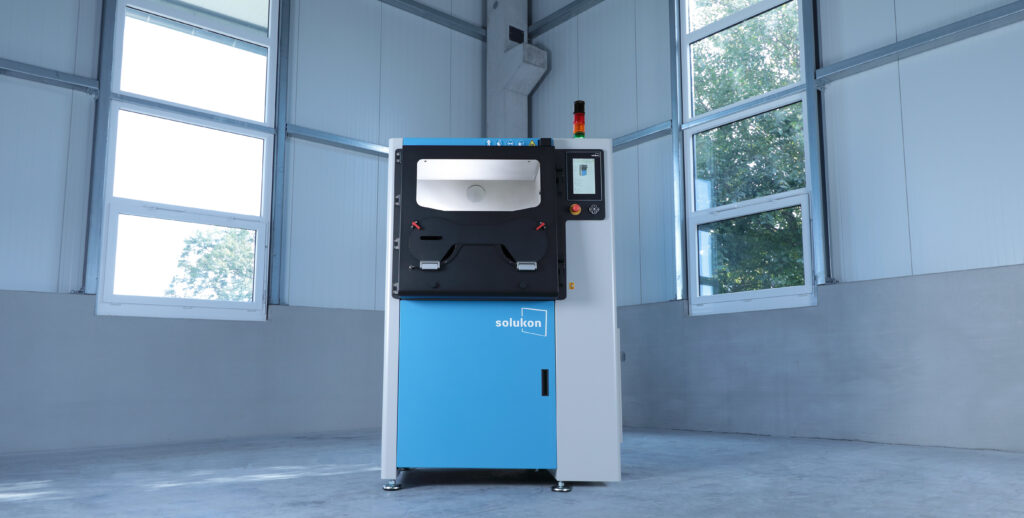
The SFM-AT350: Depowdering of medium-sized metal parts

FACTS & FIGURES ABOUT THE
APPLICATION AND DEPOWDERING PROCESS

Build plate dimensions (W x D x H)200 x 200 x 350 mm
PrinterEOS M 400-4
MaterialIn718
ApplicationHeat Exchangers for power generation
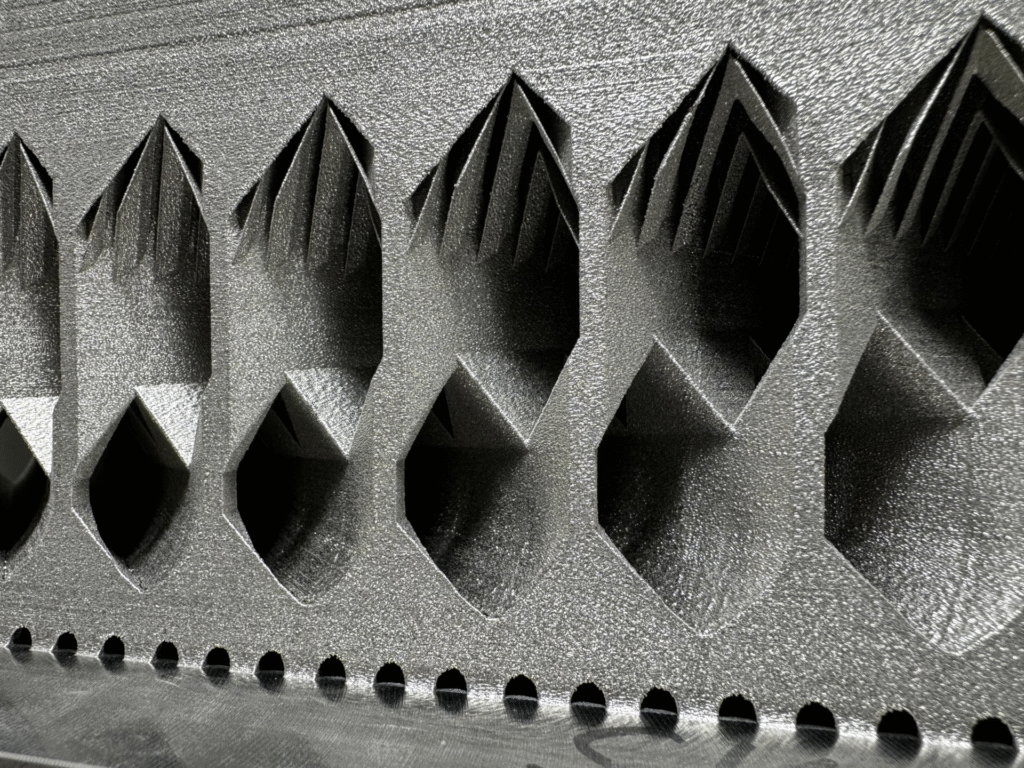
Surface / structure– Cylinder with thin walls and fuel injector inside

– Curved channels inside the part which are approx. 200 mm tall in total

– 4 parts of the same shape on one build plate
Smallest diameter of internal feature filled with powder0.2 mm
Depowdering systemSolukon SFM-AT350 with high-frequent knocker
Duration of automated depowdering process360 min
Mode usedIntel Model with SPR-Pathfinder®
Number of cleaning steps1200
Amount of recovered powder per cleaning cycle10-20 kg
How many parts of this type are depowdered?12 a week

THE DEPOWDERING PROCESS

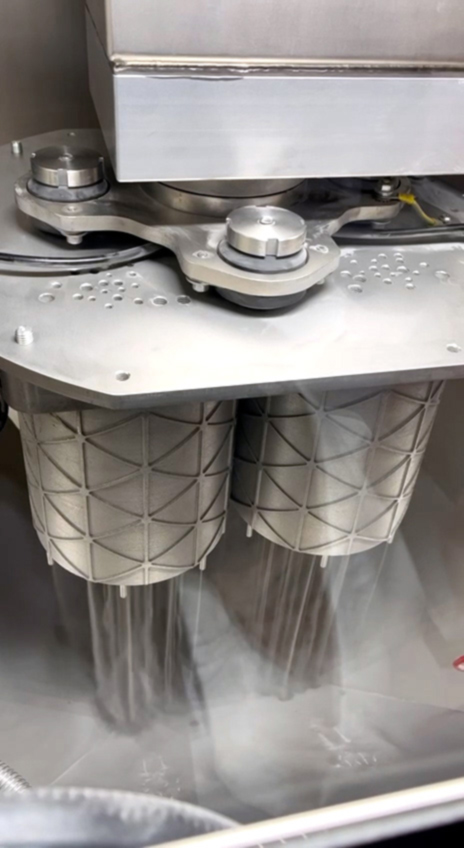
The depowdering process was carried out on the SFM-AT350 with a high-frequency knocker add-on.

During depowdering in Intel Mode with the SPR-Pathfinder®, a strong powder flow was detected. Targeted knocking helped loosen powder clogs in small part cavities (smallest size: 0.2 mm). Overall, the depowdering process for the heat exchangers in the SFM-AT350 took six hours. About 10-20 kg of powder could be collected for each depowdering cycle. Team Enerbine reuses the powder after sieving it for further printing processes.

After the depowdering process, Team Enerbine cut the parts open using an EDM. No powder residue was trapped inside the geometry. “Before we used the Solukon, powder was still trapped in the thin walls. Now, with the Solukon, only some dust remains on the walls”, says Erling LaSalle, Additive Manufacturing Engineer at Enerbine.

The depowdering process is followed by rinsing with IPA, heat treatment and machining.
SAFE PROCESS, LOW MAINTENANCE

Installing a Solukon depowdering system has significantly improved occupational health and safety because the powder is processed in a sealed atmosphere. The Solukon unit’s minimal maintenance requirements make it a valuable addition to Enerbine’s additive production facility, boosting efficiency.
THE ADVANTAGES OF DEPOWDERING WITH SPR-PATHFINDER® OVER CONVENTIONAL DEPOWDERING

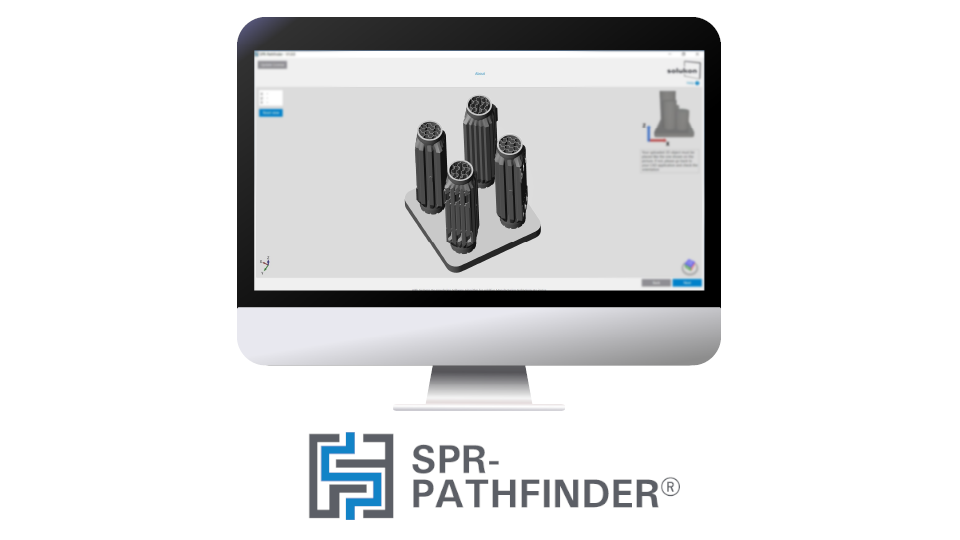
Enerbine has found significant advantages in intelligent depowdering with SPR-Pathfinder®, which involves the precise precalculation of component movements based on the part geometry. Erling explains:

„Before we had the software, we set the program manually and ran it for 8 to 12 hours, but powder would still remain trapped inside the part. With the Pathfinder program, the process takes only 6 hours, and all the powder is completely removed.”

SPR-Pathfinder® is especially useful because the design of the heat exchanger is still being developed and changes slightly with each print. The software can quickly account for these minor changes to the component.

THE NEXT STAGE IN ENERBINE’S GROWTH IN INDUSTRIAL DEPOWDERING

Currently, the SFM-AT350 depowders up to four components on one build plate at a time. This will exceed the SFM-AT350’s maximum weight capacity soon, so Erling’s team plan to upgrade to the next largest Solukon depowdering system: the SFM-AT800-S. “We will need an SFM-AT800-S for full production setting”, Erling states.
case
study

Automated depowdering with ultrasonics – Use case justairtech

Learn in this case study for which geometries ultra-high frequencies can make a difference for depowdering.

August 5 2025

INTRODUCTION

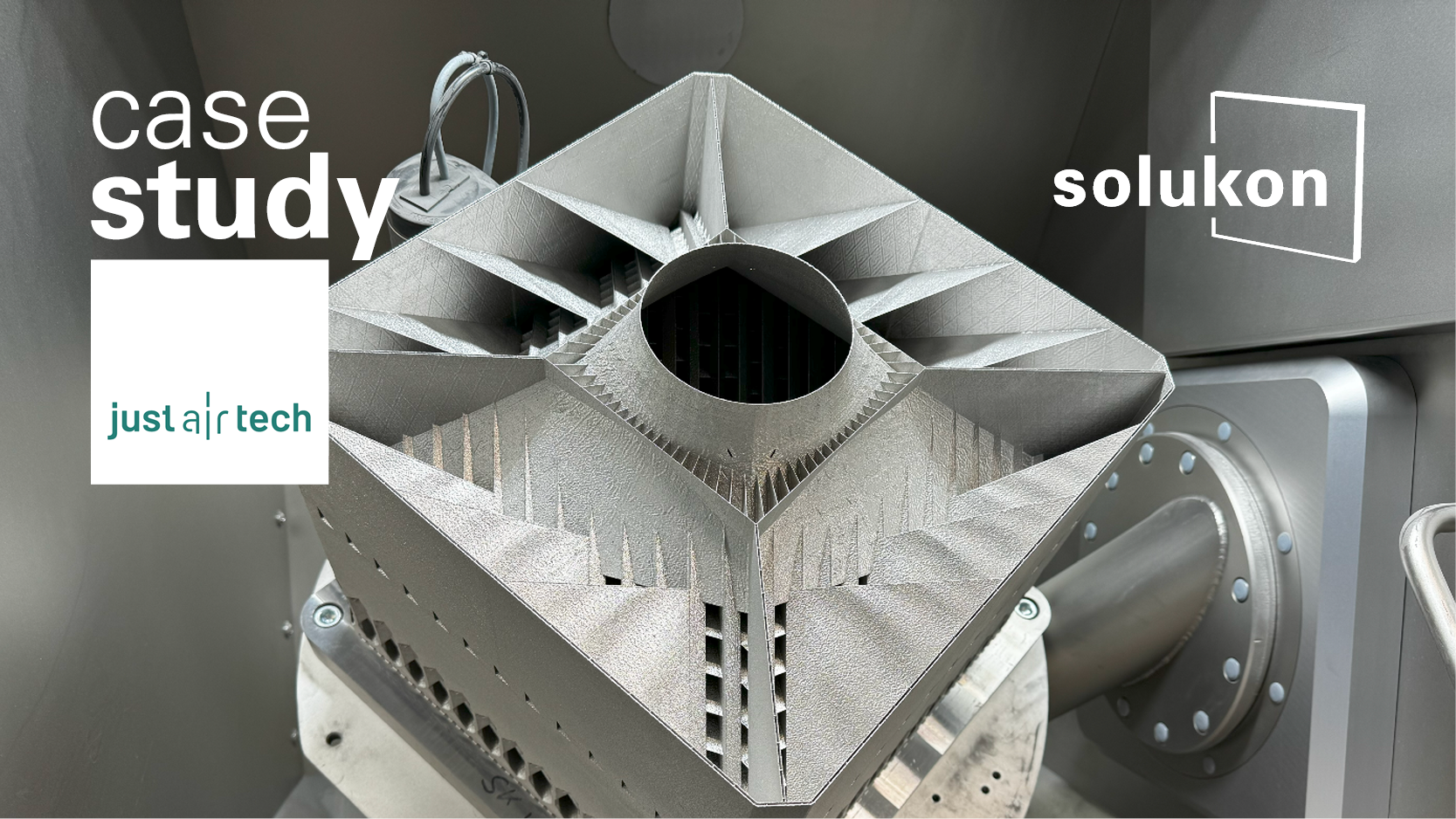
For nearly a decade automated depowdering was widely understood as the combination of automated rotation and targeted vibration. This is still the case but with the launch of the depowdering system SFM-AT350-E Solukon has extended the vibration options with ultrasonic excitation. This case study features the ultrasonic depowdering process of a Fractal Heat Exchanger by justairtech.

The company develops and provides sustainable, highly efficient cooling systems that use air as a refrigerant, primarily targeting data centers and industrial cooling needs. The use case part, their fractal heat exchanger, is their core technology, enabling the use of air as a refrigerant and achieving 4-5 times higher efficiency than conventional systems. They aim to decouple cooling from climate change by reducing electricity consumption and using natural refrigerants.

FACTS & FIGURES ABOUT THE
APPLICATION AND DEPOWDERING PROCESS

Build plate dimensions (W x D x H)350 x 350 x 350 mm
Printer with which the part was manufacturedEOS M 400-4
MaterialEOS Stainless Steel 316L
ApplicationFractal Heat Exchanger
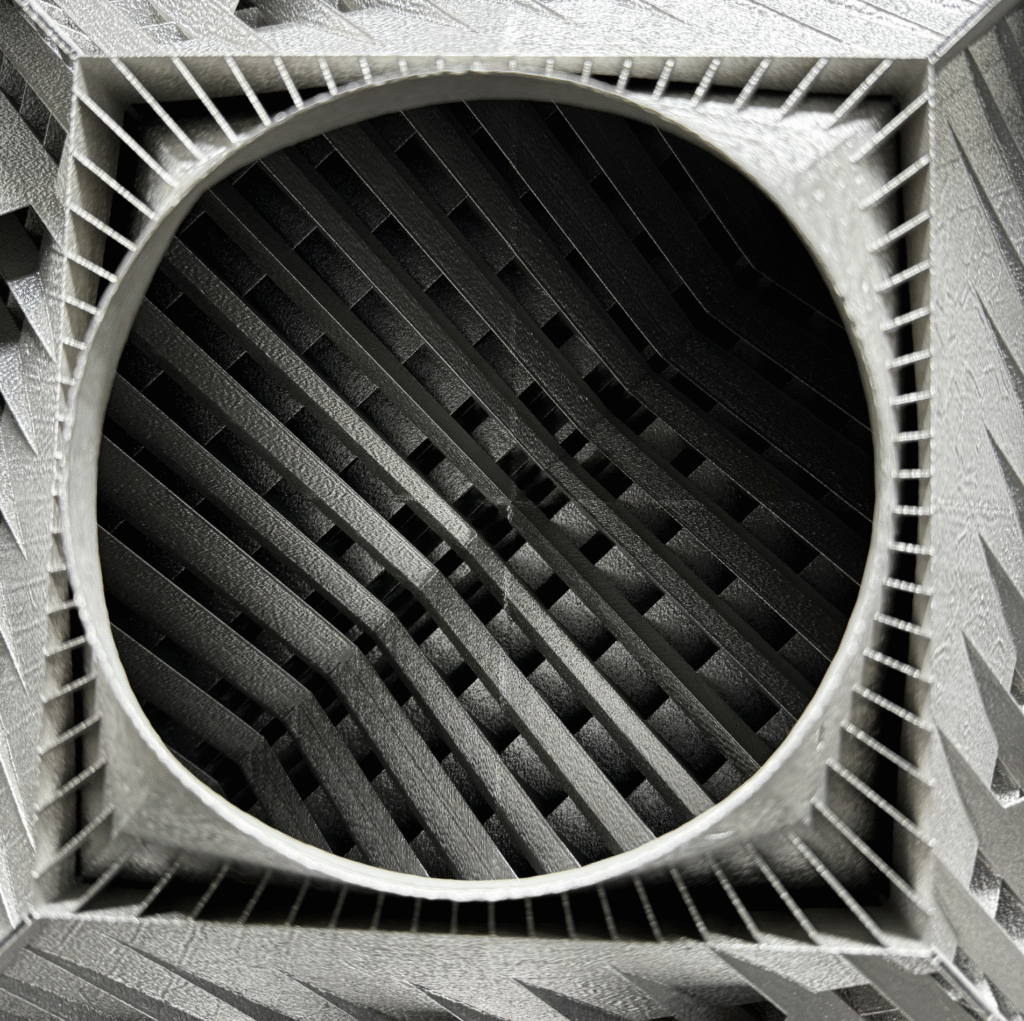
Structure / surface– Complex internal geometry with many horizontally running, long and narrow channels; Channel opennings of various geometrical
shapes

– Spread over the entire base area, approximately halfway up: an
area (100 – 150 mm high) in which there is a vertical grid with
extremely small gaps (“channels” of 0.5 x 0.5 mm).
Smallest diameter of internal feature0.5 x 0.5 mm
Duration of automatic depowdering337 min
Depowdering systemSolukon SFM-AT350-E with ultrasonic excitation
Mode usedAutomatic Mode + Manual Mode

THE DEPOWDERING PROCESS

Before the ultrasonic depowdering process in the SFM-AT350-E a pre-cleaning has already been conducted. There was a period of time between the first and second cleaning during which the component was exposed to normal room air. It can therefore be assumed that the powder remaining inside the part reacted with moisture from the surrounding air, which further complicated the depowdering process. The depowdering process was carried out on the SFM-AT350-E with permanent ultrasonic excitation and without an option for a pneumatic vibrator or high frequent knocker. During the depowdering also a high impact blasting gun was used to additionally loosen the powder and to get even more powder out of the part. During depowdering in automatic mode (swiveling angle 60°-220°, rotating and swiveling speed 10°/s with waiting times of 5 seconds in each position) a strong powder flow was detected. All in all the ultrasonic depowdering process of this Fractal Heat Exchanger on the Solukon SFM-AT350-E took 337 minutes. Despite pre-cleaning, more than 1.9 kg of stainless steel powder that had attached could be removed. The Heat Exchanger is now completely depowdered.

WHAT IS THE RESULT OF THIS USE CASE?

This use case clearly demonstrates that ultrasonic excitation can make a significant difference when dealing with narrow, long channels. Considerably more powder was removed compared to conventional pre-cleaning using vibration and knocking. Ultrasonic cleaning with the SFM-AT350-E is another powerful tool in Solukon’s comprehensive industrial depowdering toolbox. However, the choice of excitation method still heavily depends on the geometry of the part.

WHAT CONCLUSIONS DOES JUSTAIRTECH DRAW FROM THE POWDER REMOVAL TEST?

“The powder removal test impressively confirmed that even powder that gets stuck in component areas that are extremely difficult to access – in our case over 1.9 kg – can be removed automatically. The comparison with the target weight of the heat exchanger shows that the test with Solukon was extremely successful and that the component is now free of powder. This not only provides us with the necessary process reliability, but also strengthens our confidence in the industrial series application of additively manufactured components.”

Philipp Komurka,
Head of Product Development & Technology
Additive Components & Testing

NEWS

Ultrasonic depowdering: A new tool in the industrial powder removal toolbox

Learn why ultrasonic depowdering can be a game-changer and when the excitation form is the right choice for your application.

July 4 2025

THE PRINCIPLES FOR AUTOMATED DEPOWDERING:

Automated depowdering is a relatively new discipline in additive manufacturing and still: since Solukon was founded and the world’s first depowdering system, the SFM-AT800-S, was launched in 2015, a number of successful principles have become established on the market. The most important of these include:

1. Depowdering must take place in a protected atmosphere

Health risks from fine dust and the danger of explosions are effectively controlled only when using a sealed process chamber. For reactive materials, the process chamber is inerted with a protective gas.

2. Depowdering must be reproducible

This means achieving consistent cleaning results for identical components (i.e., repeatability). What may sound obvious or like a no-brainer is actually a standard that can only truly be maintained with automated powder removal using Solukon.

3. The best cleaning result is achieved through the combination of rotation and vibration excitation

(Endless) rotation around two axes and targeted vibration excitation make the adhering powder flowable within internal channels. The excitation intensity of the vibrator can be adjusted in Solukon’s powder removal systems. However, how the pneumatically generated vibrations actually act on the part is highly individual and depends on the geometry of the component. What matters is the result: the powder behaves like a liquid and flows out of internal channels. Powder clumps are broken up by a high-frequency knocker, which can also be activated when needed.

Until recently, the combination of a pneumatic vibrator and a knocker to stimulate vibration would have been on this list of basic principles for depowdering. This is because pneumatic vibrators are reliable, cost-effective and highly efficient. However, they consume large amounts of compressed air and are difficult to control, which can lead to problems with sensitive parts. This is because exceeding the resonance frequency could damage the parts in sensitive structures.

SFM-AT350-E with ultrasonic excitation

SFM-AT350-E with ultrasonics

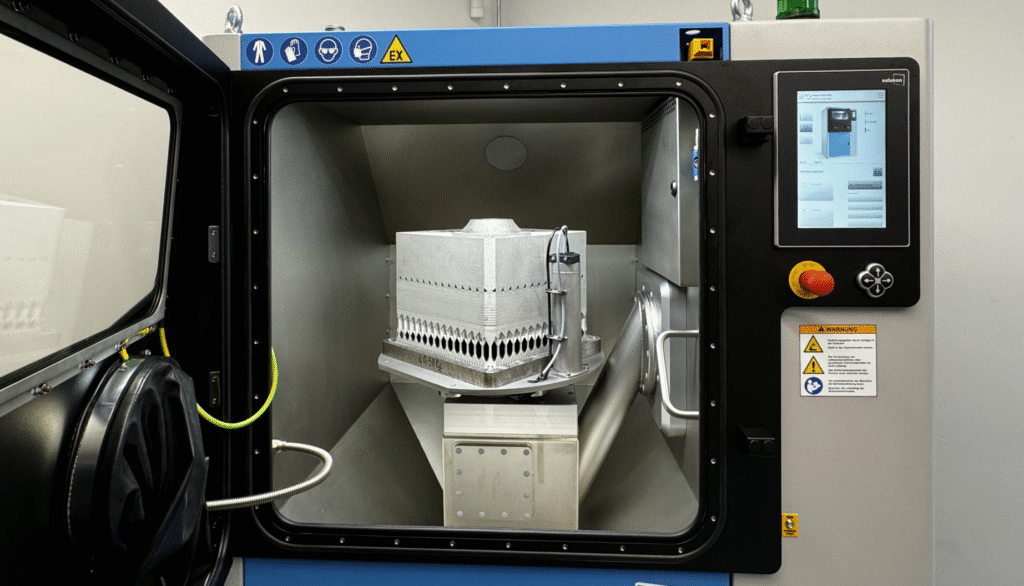
With the introduction of the E version of the SFM-AT350 depowdering system, Solukon has therefore expanded the toolbox of excitations and brought a system with ultrasonic excitation onto the market. The SFM-AT350-E depowders components up to 400 x 400 x 400 mm and 100 kg fully automatically with programmable 2-axis rotation and frequency excitation in the ultrasonic range.

What can ultrasonic excitation do, and what are its key advantages?

In the SFM-AT350-E, the component is excited at ultrasonic frequencies using a piezoelectric system. The excitation is applied directly at the turntable of the automated depowdering system, allowing the component to be brought effortlessly and precisely into an optimal vibration state. What makes this approach unique is that instead of using a fixed frequency, the system continuously and rapidly sweeps through a specific frequency range in which cleaning is particularly effective. This sweeping ensures highly reliable cleaning by utilizing well-defined frequencies within the ultrasonic range.

The ultra-high frequencies used for electrical excitation are well above the component’s potentially damaging natural resonance frequency. This prevents the component from resonating and eliminates the risk of structural damage. As a result, ultrasonic depowdering is an especially gentle form of cleaning.

Another advantage: ultrasonic excitation is completely silent. This allows the
SFM-AT350-E to be installed even outside noisy, high-throughput production environments.

When is ultrasound the appropriate form of excitation?

As with many challenges related to powder removal, choosing between pneumatic and ultrasonic excitation largely depends on the specific application and the geometry of the component. Both methods can deliver effective cleaning results. However, ultrasound is often the preferred option for parts with extremely delicate features or fragile support structures, as it avoids the oscillations typically associated with pneumatic excitation—greatly reducing the risk of component damage from vibrational stress. Even very fine structures (typically less than 0.5 mm in diameter) respond exceptionally well to high-frequency ultrasonic excitation.

In addition, powder can become clogged in narrow and deep channels if the excitation is not applied correctly. Ultrasonic excitation is capable of reliably cleaning such channels and can even dislodge existing blockages. The following comparative test conducted by a Solukon customer highlights the advantages of ultrasonic technology in cleaning narrow and long channels:

What specific use cases are there?

Swissm4m: Depowdering of medical parts

The SFM-AT350-E has proven to be an ideal system for the medical industry in particular. Typical applications here are hip cups, which have a grid-like structure on the surface. Such acetabular cups, together with spinal inserts and dental tools, were part of a build job at the Swiss m4m Center, a technology transfer center for the medical and dental industry.

Ultrasonic depowdering of medical parts


Medical parts inside an SFM-AT350-E

It took just 7.5 minutes to clean the stainless-steel medical components in the SFM-AT350-E with ultrasonic excitation.

The Exploration Company: Depowdering of a Thruster Combustion Chamber of a rocket engine

The ultrasonic technology of the SFM-AT350-E has also already proven itself in the aerospace industry, where particularly high demands are placed on industrial depowdering. International aerospace company “The Exploration Company” relies on ultrasonic excitation with the SFM-AT350-E from Solukon for the depowdering of rocket parts.

This combustion chamber made of Inconel (IN718) weighs around 15 kg, is around 370 mm high and has a highly complex interior: the intricate channels are up to 400 mm long, and the smallest diameter of these channels is 1.5 mm.

Thruster Combustion Chamber by Exploration Company

With the SFM-AT350-E, the team led by Senior Additive Manufacturing Engineer Maxi Strixner was able to clean the component comfortably, gently and silently. For the targeted cleaning of the rocket combustion chamber, the team ran a cleaning program specially written for the component. After 30 minutes, the component was successfully cleaned.

Ultrasonic depowdering of a Thruster Combustion Chamber

For the Exploration Company, the silent cleaning and the reliable cleaning quality are the main reasons why they chose the SFM-AT350-E from Solukon:
„The Solukon ultrasonic depowdering system has been a game-changer for our small workshop. Its quiet design means we can run it right next to our workspace without any disruption — which is a big plus. When used with a program, the system drastically cuts down on manual labor, and delivers consistent, clean results. All of this translates into real time and cost savings, making the investment absolutely worthwhile”, says Boris Schaff, Additive Manufacturing Engineer at The Exploration Company.

Ultrasonic technology as a new tool in the powder removal toolbox

As the examples show, the ultrasonic technology of the SFM-AT350-E has already proven itself on the market. And still: the E-version is by no means a replacement for the SFM-AT350’s standard depowdering technology with pneumatic excitation. Ultrasonic excitation is rather an additional tool in the toolbox of automated depowdering.

NEWS

Depowdering of rocket parts: The Exploration Company relies on ultrasonic system from Solukon

The Exploration Company is investing in the intelligent and automated postprocessing of 3D-printed components.

January 20 2025

The international aerospace company focuses on sustainability in the production of flight systems and develops reusable space capsules. With a Solukon SFM-AT350-E with SPR-Pathfinder® software, The Exploration Company is investing in the intelligent and automated postprocessing of 3D-printed components.


In recent years, the New Space sector has become one of the most important and highest-revenue industries for Solukon. With the Exploration Company from Planegg in Bavaria, the Solukon team has won another heavyweight in European space travel as a customer.

Senior Additive Manufacturing Engineer Maxi Strixner opted for an SFM-AT350-E with SPR-Pathfinder software for the depowdering of rocket components. The SFM-AT350 is the best-selling depowdering system for medium-sized components weighing up to 100 kg. The E-version of the depowdering system used by the Exploration Company uses piezoelectric ultrasonic excitation to clean laser-melted metal parts particularly quickly and gently. This technology, which was newly developed by Solukon, is unique on the market and enables a silent and efficient cleaning process.


Solukon CEO Andreas Hartmann and Hélène Huby, CEO of the Exploration Company in front of the Solukon SFM-AT350-E.

Why intelligent depowdering is key in space industry

The production of rocket components for the Nyx space capsule requires maximum precision in all production steps. To ensure that everything runs smoothly during the flight of the space capsule, printed components must be completely free of powder. The Solukon system more than meets these high cleaning quality requirements. “With the SPR-Pathfinder software, we calculate in advance how the component must be moved so that all the powder runs out. This enables us to achieve reliable cleaning results and clean components in series,” says Maxi Strixner. Cleaning can also be pre-simulated with the SPR-Pathfinder. This allows developers to see as early as the design phase whether the component can be completely cleaned or whether the geometry needs to be adapted for better postprocessing.

Sustainability in rocket construction

During the cleaning process in the Solukon system, the powder is collected without contamination and can be reused for further presses after sieving, resulting in significant material savings. In addition, piezoelectric frequency excitation offers the advantage over conventional pneumatic vibrators that significantly less compressed air is required, which enables further savings. This approach fits in perfectly with the Exploration Company’s main maxim: “Our main focus is on the development of reusable space capsules for the transportation of payloads and people into space,” says CEO and founder Hélène Huby.

NEWS

Depowdering Tool Components in Additive Manufacturing: Paul Horn GmbH relies on Solukon

With a Solukon SFM-AT350, the precision tool manufacturer Horn optimizes the postprocessing of its parts produced in the powder bed process.

June 13 2023

Horn, the technology leader in tool production, uses additive manufacturing for tool production as well as conventional manufacturing methods. With a Solukon SFM-AT350, the precision tool manufacturer Horn is now optimizing the postprocessing of the parts it produces with selective laser melting.


Founded in 1969 in Tübingen, Germany, the carbide tool manufacturer Horn is the technology leader in producing precision tools for machining tasks with high standards. Alongside 25,000 standard tools, the family-run company has delivered more than 150,000 custom solutions to its customers in recent years. For such a large volume of production orders, both the manufacturing process and the downstream process steps must be scaled to the greatest extent possible. With the Solukon SFM-AT350, Horn has automated the depowdering of laser-melted metal parts and, in turn, has significantly increased the efficiency of component cleaning.

Solukon SFM-AT350: Reliable cleaning for medium-sized parts

Based on the SPR® Smart Powder Recuperation technology from Solukon, the SFM-AT350 cleans complex metal parts weighing up to 60 kg with 2-axis rotation and adjustable vibration in a protected atmosphere. The rotary table of the SFM‑AT350 is infinitely rotatable, while the horizontal axis swivels by up to 250 degrees. This fully automated process removes residual powder from the complex channels inside the parts.

Depowdering tool parts at Horn

The SFM-AT350 is in use several times a week at Horn. Currently, parts made from tool steel and stainless steel and those made from the reactive materials aluminum and titanium are depowdered in the Solukon system. Before cleaning the reactive materials, the SFM-AT350 is inerted with protective gas. Depending on the part size, up to several dozen parts are arranged on a build plate, which are then simultaneously freed from powder in a cleaning process in the SFM-AT350. This makes the cleaning process considerably more efficient and faster. According to Dr. Konrad Bartkowiak, production manager for additive manufacturing, when it comes to depowdering, parts with interior cooling channels, lattice structures or powder residue in the support structures are the greatest challenge.


With the SFM-AT350, the company from Tübingen cleans these complex parts automatically and has complete transparency in terms of the cleaning process. This is made possible by the Digital-Factory-Tool, a sensor and interface set used to monitor all the key data of the depowdering process (e.g., humidity, chamber pressure, temperature).

Michael Schäfer, Designer and System Operator in Additive Manufacturing at Horn, operating the Solukon SFM-AT350.
Credit: HORN/Nossek

Main benefits: increased occupational safety and powder recuperation

Alongside the increase in efficiency, Horn decided in favor of a Solukon system for reasons of occupational safety. “The Solukon system increases safety (explosion protection) because we can also use it to depowder metal parts made of reactive materials in a protective gas atmosphere,” said Bartkowiak. Bartkowiak and his team also rely on the Solukon system for its contribution to sustainability. “We can sieve the discharged powder and then reuse it. Depending on the part size and cavities, this can add up to a significant amount of powder,” said Michael Schäfer, a designer and system operator in Additive Manufacturing at Horn.